John Coltrane on Jazz Casual
This Sunday we have something exquisite. Almost 30 minutes of Jazz brilliance.
Simply sit back and enjoy.
Ladies and Gentlemen, Mr. John Coltrane and his quartet.
Until next time.
Ignacio

©2017 by Ignacio Alperin Bruvera

This Sunday we have something exquisite. Almost 30 minutes of Jazz brilliance.
Simply sit back and enjoy.
Ladies and Gentlemen, Mr. John Coltrane and his quartet.
Until next time.
Ignacio
©2017 by Ignacio Alperin Bruvera

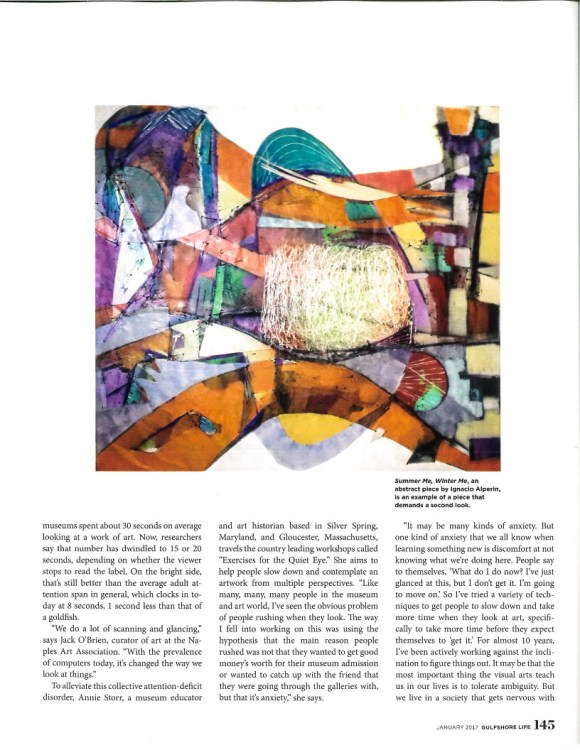
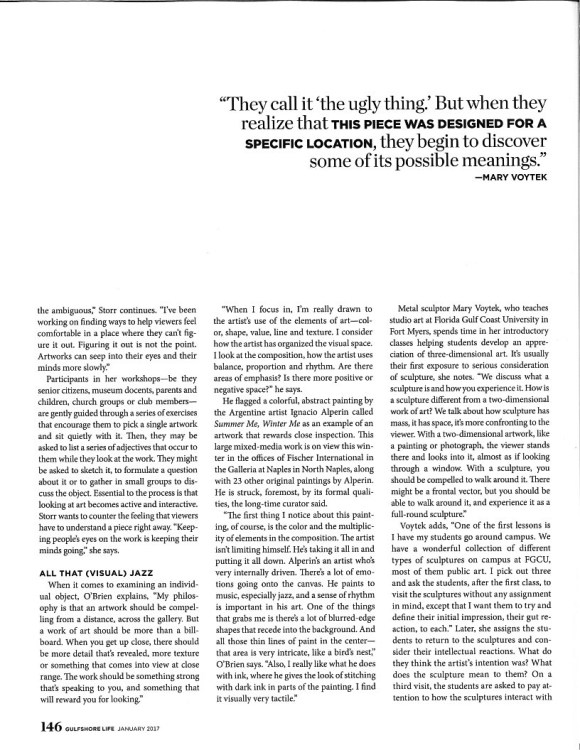
REVISTA GULSHORE LIFE, Enero de 2017. Artículo/Review sobre la mirada creativa. Una de las 3 obras seleccionadas para analizar es “Summer me, Winter me”, obra que realizara en 2015. Espero que lo disfruten. Muy agradecido a Gulfshore Life Magazine y al curador Jack O´Brien por la enorme gentileza.
GULFSHORE LIFE MAGAZINE, JANUARY 2017. Article/Review about viewing art creatively. One of the 3 pieces selected for the article is my painting “Summer me, Winter me” from 2015. I hope you enjoy it. And a big thank you to Gulfshore Magazine and curator Jack O´Brien for the comments and the inclusion in the Magazine (which I am proud to say is my 4th in less than year!)



Until next time.
Ignacio

©2016 by Ignacio Alperin Bruvera

CREATIVITY
We usually talk respectfully about “talented” individuals, companies look for “new talent”, while the media reviews and applauds “talented” performers. Some of us may have even dreamt -or may still hope- to be in consideration for that label. And why not? It would seem people openly considered as “talented” have the world at their feet. But what is really talent? Or at least, what qualifies as talent in these situations? Furthermore, is there such a thing as a “talented individual”?
Merriam-Webster defines talent, in this particular usage, as “1. archaic : a characteristic feature, aptitude, or disposition of a person or animal, 2. the natural endowments of a person; and 3. a special often athletic, creative, or artistic aptitude or b : general intelligence or mental power : ability.”
The first obvious thought that comes to mind from looking at the definition, is that it is a very misused word. Clearly, it is one of those expressions in common usage that has become a generic term in itself. And just as for most people around the world the name Coke is a generic term (a definition in itself) as much as a brand, the everyday use of the brand Talent generates a common and accepted image no matter whether we are talking about sports, business, science, or a spelling bee competition.
Yet, moving beyond the superficial -and maybe misleading- use of the specific term, it remains so that “talent” is not something as special as one may have been led to believe. Quite the contrary, having talents seems to be as much an intrinsic part of an individual as, let’s say, being creative, having body organs or breathing.
The fact is that we all have received talents from the word go. They are our natural endowments, using the description of Merriam-Webster. They can be both our genetic (family), and personal (individual) gifts. Capacities that make up as much of who we are as any other personal characteristic. It is the stuff we are good at, as well as the things we suspect we could be good at if we gave it a serious try, those we suspect are there but we need to give ourselves the opportunity -and time- to explore them, and even those which are hidden from us and we don´t even know exist.
 In the same way as it used to be said that only some people were talented, the same happened with creative people. These days we can say – backed by strong neurological and psychological evidence, as well as with at least 100 years of relevant scientific research-, that in fact, “we are all creative”. What we are not is all “the same creative”. In a way, and in reference to “talent”, the same thing seems to apply.
So, what makes some people raise above others then? How come we generally recognize that, even if we are all talented, some may seem to be more so than others (following Orwell´s Animal Farm line of thought that “we are all equal, but some are more equal than others” perhaps). And what makes them more noticeable than the rest?
There are clearly common qualities that spread across the different professions and which can be analyzed. In simple terms, an approximation to the “Famous Talents” Top 10 checklist could look a bit like this:

So, on the one hand, talent is everywhere (in human and animal terms and without exception). In our specific case, wherever there is a human being (and today with 7 billion plus on the planet, that is almost everywhere) there is talent, obvious or latent. But also in society, there are those who clearly will go the extra distance and be lucky enough to be noticed, be formally labelled, and get the benefits from being openly considered as “a Talent”.
Whether we are looking to reboot our natural talents, or to either retain or hire what is commonly referred to as “new talent”, it is very possible that many of these 10 qualities we just mentioned are expected to be found (they are obviously not the only ones). So, it may be a smart move to look at the manner in which many of these people work and act. Emulating them, working hard, liberating our creative spirits, and remixing a little, may then get us a long way.
Until next time!
Ignacio
©2016 by Ignacio Alperin Bruvera

CREATIVITY
Whenever I give a creativity lecture at University, or in artist´s or corporate workshops or talks, I always commence by asking everyone if they would not mind signing an agreement with me before we start. Nothing legal, mind you. But all important when it comes to preparing the ground before we seed it with fresh concepts, or with new interpretations of old ones.
The agreement basically asks everyone to accept that, for the duration of our time together, they will pay no attention to their “inner voices”.
Some people look at me with surprise, as if hearing voices was something more related to being a little crazy than overly sane. Sooner or later, they all smile shyly as most finally admit that they all hear them (and most, to their dismay, even have full “conversations” with their alter egos).
The fact remains that, even if many of us will deny it, we all do hear voices and converse with them. They may not be like “good Homer & evil Homer” (which by the way, as many things in the Simpsons, is a take on the Flintstone´s and the “saintly Fred / evil Fred” of decades ago), but they nevertheless engage us into inner conversations about what to do, how we feel, or about the way we should react to everyday dilemmas as they compare, and weigh-in, the different possible scenarios.
While they are mostly helpful, these voices can sometimes work against us.
That is because what we usually refer to as “original thought”, is in fact mostly a remix of existing information and knowledge, plus perhaps a new take on it (many times based on our own personal experiences), or perhaps a different engagement, calculation or approach, or a combination into one of what were -until now- separate avenues of development. It is a fact that whenever one hears about a “new” idea or theory, it will resonate somehow as most of us, at some point, have either heard, seen, or read something similar, or related to it -factual or as an exercise of the imagination-.
That is the time when the little voice becomes an issue. It tells you “Oh yes! I saw that on Discovery Channel last year”, or “I read something about this in such and such review”. In other words, “This is old news”.
We feel energized by this fact because our egos love “knowing” before others, but the ensuing feeling of apparent superiority becomes dangerous. Because as a result, you may also turn off your attention from whatever you are being exposed to as “I already know what this is” (or at least you become convinced that you do) and there is no point wasting your time with it.
Every bit of information that comes your way after that moment just “bounces” of your brain into infinity. And the whole exercise simply becomes a lost opportunity to open up your mind and explore something different, something creative, and something that may ultimately move you forward (or sideways, or at least definitely somewhere else than where you are).
I could go on. But one of the most important lessons to take away from all of this should be that it is always better -much better in fact- to listen, even argue, with others rather than just discuss things with yourself. I am not denying that introspection is also part of the process, and there is always a time for it as well. But everything has a place and a role to fulfill. Without others our conclusions will be simply poorer, less empathic, and less sustainable in the long run.

Next time you are entering a creative process of your own and people try to give you their opinions or information, just press “mute” in your head, and make an effort to look and listen to everything that is being put in front of you as openly as you can, almost like in the way a child looks at something that he or she has just discovered.
The truth is that every individual view of one same event is slightly different. Our brain is the filter between “reality” (which is no more than a perception of whatever is “out there”) and who we are. Each brain is a unique sift, and everybody´s views will enrich a result. They will definitely make it better and different -and perhaps they will even make it unique, or help you make it unique-.
So whenever you are presented with something that may be new, and “the voice” begins to play havoc, try to follow this little guide:

I can promise that you will not regret it.
Until next time.
Ignacio
©2016 by Ignacio Alperin Bruvera
 IGNACIO ALPERIN: THE ART OF THINKING OUT LOUD / EL ARTE DE PENSAR EN VOZ ALTA