A personal, curatorial & bilingual Blog about: Artistic Movements, my Art, Creativity, Innovation, Design, Leadership, Empowerment, Sustainability, Science, Jazz, Movies and other cool pursuits - Blog personal y curatorial bilingüe sobre: Movimentos Artísticos, mi Arte, Creatividad, Innovación, Diseño, Liderazgo, Empoderamiento, Sustentabilidad, Ciencia, Jazz, Películas y otros temas.
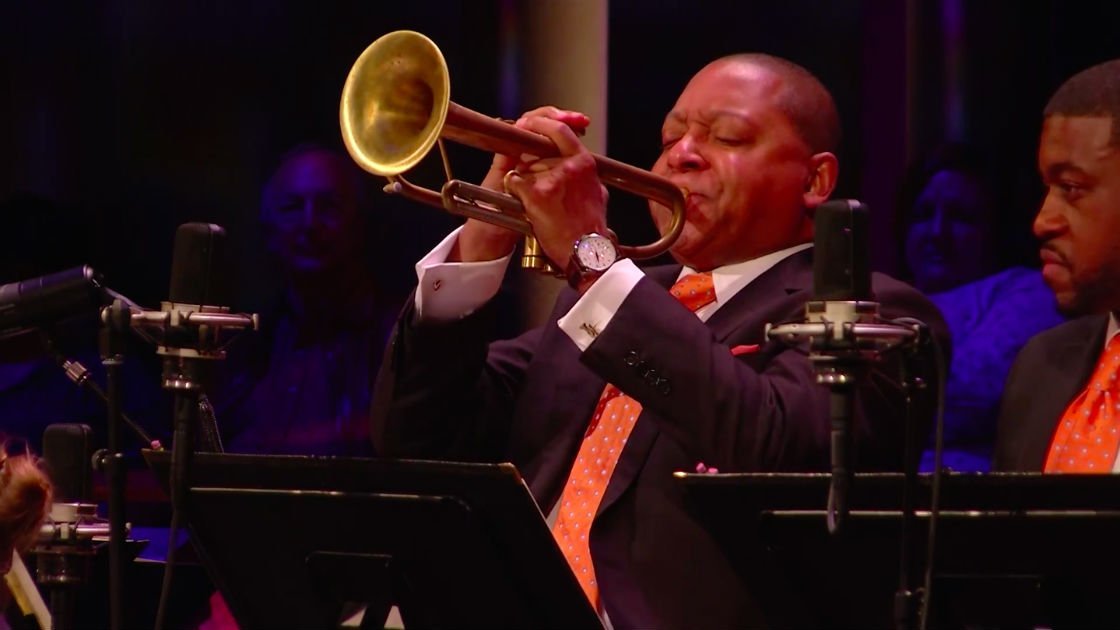
This is Jazz at the Lincoln Center, with Wynton Marsalis.
Presenting:
Untamed Elegance (Suite)
Composed and arranged by Victor Goines
3:51 – The Business of America is Business
11:14 – The Elephant in the Room
20:58 – Laboratories of Ideas
29:15 – The “It” Thing
36:06 – Drunk as a Skunk
44:43 – Bold, Naked, and Sensational
Personnel:
Sherman Irby – Alto saxophone
Ted Nash – Alto saxophone
Victor Goines – Tenor saxophone
Walter Blanding – Tenor saxophone
Paul Nedzela – Baritone saxophone
Vincent Gardner – Trombone
Chris Crenshaw – Trombone
Elliot Mason – Trombone
Shareef Clayton – Trumpet
Kenny Rampton – Trumpet
Marcus Printup – Trumpet
Wynton Marsalis – Trumpet
Adam Birnbaum – Piano
Carlos Henriquez – Bass
Ali Jackson – Drums
Featuring Jon Irabagon on saxophones
Ignacio Alperin is an international artist based in Buenos Aires, Argentina. He grew up in Australia and has lived in several countries around the globe.
The selection of works in this exhibition were compellingly influenced by his synesthesia (”gift” he shares with Kandinsky).
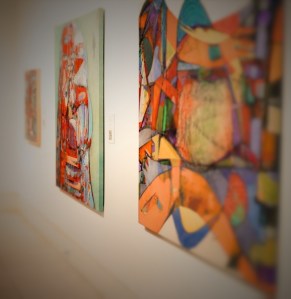
His art is full of ideas, movement and visual interpretations of musical compositions -from Jazz, Soul, Motown and the American songbook, to Tango and the Classics-.
The end result is a visual idiom that borrows from the inventive and spontaneous methods of jazz musicians. This is so much so that his style has been often described as a visual kind of jazz, or “Visual Jazz”.
We find in his paintings a marked rhythmic musicality and improvisational counterpoints, which are always based on a well thought-out idea.
While his robust use of an extended palette extracts unthought-of shades and gradations that have become a signature and a characteristic of his bold and powerful style.
SOBRE EL ARTISTA
Ignacio Alperin es un artista internacional basado en Argentina, país que lo vio nacer.
Creció en Australia y ha vivido en varios países alrededor del mundo.
La selección de obras que se presentan en esta exposición estuvo fuertemente influenciada por su sinestesia (“regalo” que comparte con Kandinsky).
Su arte se nutre en gran parte de las ideas, movimientos e interpretaciones visuales que extrae de composiciones musicales -desde el Jazz, Soul, Motown y el cancionero americano, hasta el Tango y la música clásica-.
El resultado final es el de un lenguaje visual que extrae lecciones de los métodos inventivos y espontáneos de los músicos, y particularmente del jazz. Tal es así, que en numerosos artículos, su estilo ha sido descripto como un manera visual de hacer Jazz, o “Visual Jazz”.
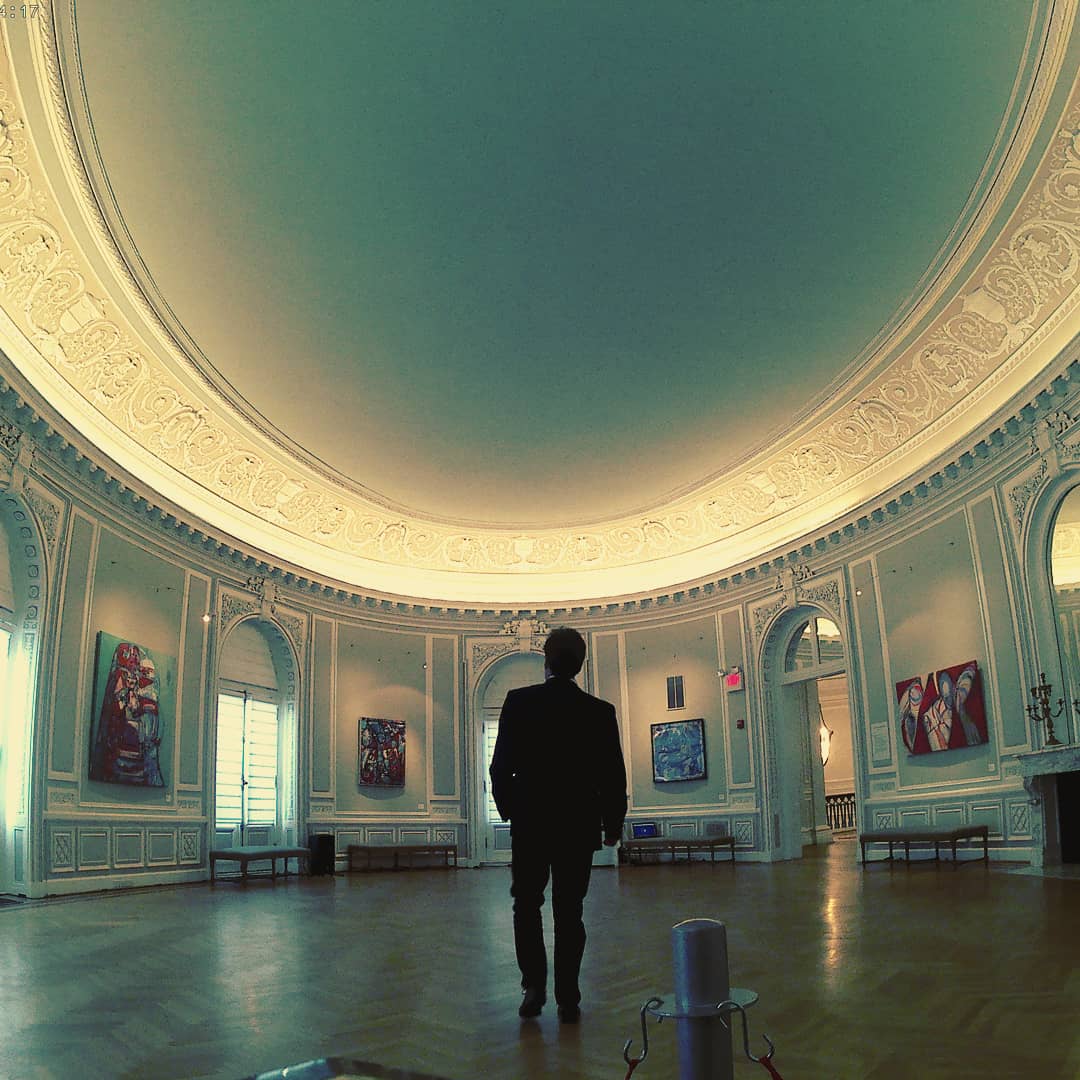
Where: Embassy of Argentina 1600 New Hampshire Ave, NW Washington, DC 20009 (M) Dupont Circle
A special thank you to Curator Bobby Donovan and his lovely wife Cyndi for their invaluable help and hospitality throughout my stay, and to all the people at the Embassy of Argentina for their support and great effort to make this a great experience for all.
Ignacio Alperin is an international artist based in Buenos Aires, Argentina. He grew up in Australia and has lived in several countries around the globe.
The selection of works in this exhibition were compellingly influenced by his synesthesia (”gift” he shares with Kandinsky).
His art is full of ideas, movement and visual interpretations of musical compositions -from Jazz, Soul, Motown and the American songbook, to Tango and the Classics-.
The end result is a visual idiom that borrows from the inventive and spontaneous methods of jazz musicians. This is so much so that his style has been often described as a visual kind of jazz, or “Visual Jazz”.
We find in his paintings a marked rhythmic musicality and improvisational counterpoints, which are always based on a well thought-out idea.
While his robust use of an extended palette extracts unthought-of shades and gradations that have become a signature and a characteristic of his bold and powerful style.
SOBRE EL ARTISTA
Ignacio Alperin es un artista internacional basado en Argentina, país que lo vio nacer.
Creció en Australia y ha vivido en varios países alrededor del mundo.
La selección de obras que se presentan en esta exposición estuvo fuertemente influenciada por su sinestesia (“regalo” que comparte con Kandinsky).
Su arte se nutre en gran parte de las ideas, movimientos e interpretaciones visuales que extrae de composiciones musicales -desde el Jazz, Soul, Motown y el cancionero americano, hasta el Tango y la música clásica-.
El resultado final es el de un lenguaje visual que extrae lecciones de los métodos inventivos y espontáneos de los músicos, y particularmente del jazz. Tal es así, que en numerosos artículos, su estilo ha sido descripto como un manera visual de hacer Jazz, o “Visual Jazz”.
Regalar y regalarse arte implica dar algo que permanece en el tiempo. En el caso de un regalo a otros, es un acto que constantemente le recuerda a quien lo recibe el cariño de quien lo regaló. Es obsequiar algo tan maravilloso como los trazos del alma de un artista, es dispensar emoción, es promover cultura, es fomentar el crecimiento y la maduración de un país a través de una de sus expresiones más nobles y enriquecedoras.
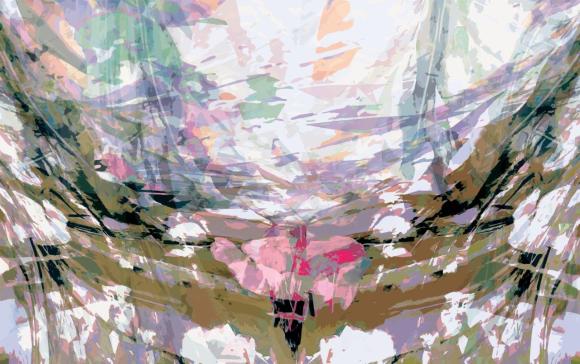
Mi serie de obras de arte digital nacen en la experimentación que se produce al plasmar ideas y conceptos directamente sobre la pantalla táctil de una computadora. Con lápiz electrónico en mano y diversos programas de diseño, mis obras cobran las texturas y tridimensionalidad de obras pintadas a mano, pero con la profundidad que les brinda el entorno digital.
El resultado es arte digital que a primera vista no parece serlo, o al menos no parece ser lo que comúnmente entendemos como arte digital.
Hay transparencias, “chorreados”, líneas, profundidades, fragilidades, luces y sombras que generan una visión de obra tradicional.
Por sugerencia del Curador Jack O´Brien, mis obras digitales (al menos por el momento) se imprimen en series limitadas directamente sobre metal en una imprenta de alta tecnología, especializada en impresiones de arte, en los EE.UU.
Cada obra cuenta, al igual que una tradicional serigrafía pero con tecnología del siglo XXI, de numeración y firma de puño y letra. Una vez terminada cada serie, la misma no se vuelve a reproducir y eso garantiza la revalorización de cada ejemplar. Cada obra llega a tus manos con su certificado de autenticidad, y como bonificación, en el caso de la primera serie de 8 pulgadas por 8 pulgadas e impresas en metal que se comercializan en la Argentina, las mismas se entregan enarcadas y listas para colgar.
El valor de cada una de las obras de la primera edición, en medida de 20cm x 20cm (8 pulgadas por 8 pulgadas), enmarcadas, con paspartú, bajo vidrio y listas para colgar (medida final es de 33cm x 33cm), es de US$150. Las rectangulares (en marco cuadrado de la misma medida) es de US$180.
Los interesados, pueden contactarse conmigo a través de la web (www.ignacioalperin.com), de mi correo electrónico (ignacio@ignacioalperin.com) o con Claire Lombard (clombard@ignacioalperin.com).
I have been back in Argentina since 1997, after many years abroad since my childhood.
I believe I have gained through the years, a fairly deep understanding of the regional environment as an artist, lawyer, and through leadership roles in different companies and organizations over the last 20 years, as well as because of my personal and professional interest in geopolitical and cultural trends.
While sustainability and conservation have become part of the lingo in our part of the world, there is still certain superficiality and misunderstanding as to the real nature of the massive cultural and business shift that is advancing worldwide.
I am Professor of Creativity and Innovation for the MBA’s at the National Catholic University here in Buenos Aires, and I must say that I am always surprised at the little understanding of the changes that many young (and not so young) high level managers still profess at the start (and how much they change by the end).
I am proud to say that I take them through a dizzying ride of empowering course contents that are the result of my own professional and personal experience. And I am grateful at the University for its openness and excitement at trying out a novel approach to teaching. Ours is a construction, carefully intertwined, between concepts of sustainability, respect for the environment, art, creativity and innovation, sprinkled with quantum mechanics, space exploration, game theory, logarithms, relativity, laws, social responsibility, and obviously, faith.
As I always tell my students at the start of the course, the 20th Century produced amazing advancement through, amongst others, the concept of the “me society”. The positive advances achieved were, on the other hand, burdened by the misconception that the planet in general, and its biosphere in particular, could sustain any damage without long term repercussions.
I always say that the 21st Century has to become a lot less about “me” and a lot more about “us” (I call it the “WE” Century).
Creativity and innovation are no longer detached from sustainability, ecological parameters, a deeper understanding of universal laws, ethics and integrity, and from our responsibility to the community in general. Our role must be seen within a holistic approach to solutions where we must endeavor to be systemic, and therefore no one in particular, but the conjunction between the different actors in society, produce the desired results.
To do that, you need a fairly leveled playing field (or at least one with clear rules), enforcement that is real and present, and within that set of parameters, creativity and innovation that can have long term effects, may finally occur and flourish in the best possible sense.
What we see in Argentina, and in many of our neighbors, is that the rules (the lines in the playing field) are mostly there and in some cases, are very cutting edge.
Yet, in some cases, and because the concepts and rules have been taken from laws and regulations that are being applied in countries that are, either much more advanced in these areas, or at least, are more advanced in their respect for the rule of law, we find that the end result is an almost impossible practical application of many of their principles.
To that general context, we must add that the enforcement agencies have been given few “teeth” and their capabilities are quite limited, while the Judicial system is fairly slow to react. And as we know, laws without prompt and practical legal enforcement, become dead letter very soon.
To that, it is also true that there are very few regulatory incentives for businesses to take the plunge. And it is also there where change can be promoted.
On the business side, sustainability is slowly being understood by the major corporations. We have come from the mere use of “sustainable referencing language”, to slowly attempting to introduce sustainability into the DNA of each business. Many are finally working today while preparing for tomorrow, as they realize the real economic and financial benefits of sustainable growth, and the potential of adding to all that, the benefits of innovation and creativity (in regards to products, services, methods and so on).
I believe there are a great deal of opportunities in Argentina, and the region, yet to be explored. And I also believe that this may be a great time to explore them.
Conservation history teaches us that at the genesis of any movement to save a place around the world, there has always been one emotionally and ethically inspired citizen. One person who has mobilized communities, who has created engagement, and who has generated the long term constituency that will preserve change.
We know that we are facing, despite the enormous progress obtained until now, a bit of an uphill battle.
We know for a fact that, at least in the North, Millennials and the X generation are not showing the same kind of connection to traditional Parks and protected areas as Baby Boomers did. And Argentina, and South America, seem to be moving in the same direction. They cannot relate to it and they need us to make that connection.
That, instead of being a problem, may become a great opportunity.
The traditional view of separate, almost isolated, protected areas may not be the correct way as we go forward in most cases. We understand now that every preserved area is part of a larger system and must be connected to it, must be emotionally attached to the community, and must generate a constituency that will sustain it in the long run.
While many have already embraced this shift, there are in our countries many business leaders, and particularly large landowners who own areas which can be protected and made environmentally sustainable, that do not trust, or simply do not understand, neither the purported benefits of this shift in general paradigm nor the potential for the win-win situation that can be generated from it.
In the case of Argentina, at least, the problem seems to be the disbelief by many, that government (whom they do not trust because of decades of mismanagement, contradictory legislation, inflation, lack of incentives, lack of medium and long term planning, and in some cases little respect for private property) can do the job.
And that is why we need honest brokers (individuals and organizations that can present innovative solutions that are systemic and full of counterbalances (Government, Venture Capital, Multilaterals and NGOs, Technology, and obviously Business), and which can produce results that engage and with wide ranging benefits in mind.
Sustainable strategies can produce real environmental, community based positive long term results that in the case of business, can also be very profitable, and in the case of nations, become the next level of long term sustainable growth. And we know that sustainable, long term growth, is the key to strong communities, large middle classes, and the path to eliminate poverty and incorporate those who were left out until now into a wider, more inclusive society.
It is time to convince political leaders, business influencers and landowners, to aspire to become that “one person” in their impact area, that will go down in history as a promoter and the center of that change.
To make it so, and to be able to also engage and convince the new generations (from Millennials onwards), one must be where political decisions are made, where opinion makers speak and cultural trends are born and expanded. Paraphrasing the WCU, it is the “urban imperative”.
The truth is that very soon almost 60% of the world population will live in cities. And it is there, in the great capitals and in the cities where people live, the place where we can make a difference. People must make the difficult connection from their urban habitat, and to do that we must not only engage and inform, we must enamor and create our constituency. And their voice will help us convince decision makers (government and business) to come to the table.
At the center of all of it, it is about moving hearts and minds. In my class I always say that the emotional factor must never be discarded. The force of sheer scientific numbers will always impress, but it is necessary to engage people at their emotional intelligence level. Particularly in South America, where our very Latin roots make us more emotionally open.
Let´s start to make a difference, each one of us in our own area of influence. This is no longer a matter of a few enlightened or of fringe groups. It is already here and it is the new society, and the new economy, that is coming towards us (and in many cases, it is already here).
The paradigmatic change is already moving the ground from underneath our own feet. Let go of what is old, and embrace all that is good in this shift of major boundaries. And remember, that at the center of it all, it is not a matter of you making it to the other side, it is a recognition that either we make it together, or we will not make it at all.
First time we have him at the Sunday Concert. While never matching his great recording prowess during live performances, this concert shows him at the peak of his writing career and at full voice (and body size). And as a note of color, please note the cigarette dangling from his hand while he starts singing…
Barry White was, in the 70´s and early 80´s the epitome of cool (with all its political incorrectness and wonderful rhythms).
During the course of Barry White´s career in the music business, he achieved 106 gold albums worldwide, 41 of which also attained platinum status. White had 20 gold and 10 platinum singles, with worldwide record sales in excess of 100 million. He is still one of the world’s best-selling artists of all time.
There is nothing new when I say that Art can be beautiful, mesmerizing, incomprehensible, terrifying, funny, or make you think about those things you may not want or had a chance to think about.
Art lifts you to new places, and at its most basic level, it makes your daily life much more interesting and attractive to live.
But buying art is a mystery shopping experience.
Because the value of artwork is a subjective exercise. In fact, we could say that Art is the first cryptocurrency, long before computers existed.
These may be algorithms that have not been studied enough, but just like a present day cryptocurrency, Art and new- and old- artists’ prices increase through a natural process of engagement and consideration that is passed on from person to person. A wave of word of mouth knowledge, academic considerations, and admiration that, as it flows around the globe, creates new stars and increases the intrinsic value of an artist and his or her art.
So how do you know if a price is correct? Well, in fact this may be the biggest disconnect with my comparison with cryptocurrencies. You don´t (or at least there is no obvious set of highly complex but allegedly explainable algorithms that justify its value). There is a certain understood value that the “market” will allow for a specific artwork. The problem is that there is no one market.
The traditional market could be seen as the gallery market. While a logical place to shop, the truth is that it is a diminishing market. High rental prices, high overheads in general, little regard for the career of the represented artists, little transparency (towards the buyer and towards the artist), exorbitant commissions (on average 50% of the value of an artwork will go to the Gallery plus space rental and other expenses which can mean that an artist could get paid 30% or less of the value of a painting… if they really know how much was really paid for their art, and if they do get paid).
There are good galleries of course. But many galleries have, for decades, pushed prices up for their own benefit and not for the artist´s benefit, and with little logic. Value of an artwork may increase or decrease according to how they gage their potential customer. This one looks he or she can pay some more, so we will ask for more. In another case, we need money for rent tomorrow, so we will let a piece go for less. That and the business of selling fake art works have hurt them a great deal. Those attitudes, which hinder on the value building exercise which must go behind any artist´s body of work, plus the opening up of alternate opportunities with social media, fairs, artist run events and so on, have made the wider traditional Gallery market, more or less a sinking system.
Art Fairs are divided between gallery run and artist run. In all cases these are business ventures which have the advantage of bringing people and artists together. The Gallery run Fairs are still an extension of the Gallery system. They can be a little more transparent because of the inherent competition that is intrinsic to these events. Artist run Fairs are more transparent, but they can be patchy in terms of quality and not necessarily a guide into real prices. The whole ambiance will push you to impulse buying, and you may find you bought something you didn´t actually like a couple of days later.
Online galleries are out there (Saatchi being the most famous). They are a decent mix between what I mentioned above and what I will talk about below. They usually take credit card payments and allow for returns. They mostly take artwork directly from the artists, although I know of several traditional galleries who have secretly placed art on these online galleries marketplaces.
Many artists today do self management of their careers. And that is a completely different market. Some do it on their own and some with the advise of others. In my case, I have mostly stayed away from galleries and managed my own career. Maybe it is my bad luck, but I have not been able to run across a gallery owner who has had the ethics, honesty, and knowledge that I expect. I am still hopeful I will find the right person (gallerist or Agent) that will do part of my current job, but I am still looking.
So I manage my own art career with the invaluable help of notable curators. Jack O´Brien (Naples Art Association), Anna Mish (formerly of the Manassas Center for the Arts and an independent curator), Irene Jaievsky (Museo de la Mujer, Buenos Aires), Alfredo Ratinoff (formerly at the Smithsonian and Chief Curator at the Embassy of Argentina in Washington DC and the IDB Gallery), Bobby Donovan (former Assistant Director of Arts Programs at the University of Maryland) are just some of the people whom, over the last few years, have given me good, intelligent, knowledgeable and sensible advise at different times. They have all been generous, sensitive, and above all, they are all people who love art deeply, and care about the artists above any financial consideration. I can truly say I have been very lucky.
So what would be a good guide into prices?
Well, first of all, buying directly from an artist may save you some money. No intermediaries means that you probably will pay a little less. Buying directly from the artist should also get you away from the fakes. It is more difficult. Usually it means looking at paintings online, no physical setting to look at them because the marketplace is global (unless you live close by). Most artists will give you 10 days or more to change your mind if you decide against a painting you purchase. And even though you will have to pay for the P&H of the return, as long as the painting has not been damaged, you will probably get your money back.
Reputable galleries will also give you time to change your mind (between 10 and 30 days) and they have the advantage of having the paintings on show and if not they will be online (although, again, in a global market that is the same as with direct from the artist purchases). They will take credit cards and they can give you some good (and sometimes bad) advise.
Online galleries are purely a matter of impulse buying, since you do not have any human interaction between you and the art you are looking at.
In very general terms, I always say that art sales could be divided between the impulsive (I love this, I want it now!), the emotional (a person slowly falls in love with a painter´s story and body of work, and that emotional connection makes them want to have some of it), the utilitarian (I need a painting with these colors so it enhances the wall behind my couch at home or my desk at the office, or as a gift for my friend´s house or office), the investor (this artist has increased in value by 100% over the last 2 years, I need to get some of that…), and the “I simply need something nice and that it will fit on my wall, but not too expensive please” kind of crowd.
In all cases, the combination of quality + price + ease of purchase is key. To that you must add, particularly when prices are higher, how interesting is the artist story and background, and the potential for value growth for the particular art work and the artist behind it.
Like anything, buy what you can afford. If it seems reasonable, it probably is. If it does not, it may not be, or it may be and you need to do some more background research on the artist to see if it is really worth it.
That said, make sure you also buy from your heart rather than your wallet.
When it comes to art, your heart will always give you better advise than any recommendation that anyone of us can give you. Remember, the art you buy will mostly stay with until the end. So, just like in life, it is much easier to live with someone you love than with someone you hate and only married for money!








 The traditional view of separate, almost isolated, protected areas may not be the correct way as we go forward in most cases. We understand now that every preserved area is part of a larger system and must be connected to it, must be emotionally attached to the community, and must generate a constituency that will sustain it in the long run.
 BARRY WHITE at the Royal Albert Hall 1975


 run Fairs are more transparent, but they can be patchy in terms of quality and not necessarily a guide into real prices. The whole ambiance will push you to impulse buying, and you may find you bought something you didn´t actually like a couple of days later.
 So what would be a good guide into prices?
 IGNACIO ALPERIN: THE ART OF THINKING OUT LOUD / EL ARTE DE PENSAR EN VOZ ALTA