A personal, curatorial & bilingual Blog about: Artistic Movements, my Art, Creativity, Innovation, Design, Leadership, Empowerment, Sustainability, Science, Jazz, Movies and other cool pursuits - Blog personal y curatorial bilingüe sobre: Movimentos Artísticos, mi Arte, Creatividad, Innovación, Diseño, Liderazgo, Empoderamiento, Sustentabilidad, Ciencia, Jazz, Películas y otros temas.
This Sunday Concert is dedicated to a little gem I found on YouTube not long ago.
From 1957, here is the first modern pop star, the King of the cool, the jazz voice made from honey and wine. This is Frank Sinatra in concert live in Seattle.
There is nothing new I can say about Ol´Blue Eyes, so I will just invite you to get comfortable, close your eyes, imagine you are sitting there waiting for the introduction and simply enjoy one of the best at work, live!
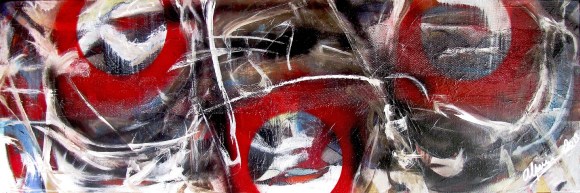
JUMPIN´OFF A CLEF (2016) by Ignacio Alperin- Macro photography detail
For an artist, doing the sure thing, the thing one feels most comfortable with, is usually something close to what is traditionally called “the kiss of death”.
Repeating the same work over and over again has often taken artists from seemingly wonderful work into the realm of the tedious.
The same way, the “system” (to call it something) tends to force its hand by pushing artists into doing over and over again, and maybe with minor variations, those paintings by the artist which “sell”.
The end result may, although not necessarily, be a profitable return on investment, but it mostly turns a creative and artistically rich individual into a laconic, easily infuriated, and mostly frustrated artist.
I have tried my best to be as flexible as possible with the market. I will not deny that I accept that if the public likes something in my work, then it is up to me to give it to them. I accept and embrace the market. But I also make the effort to keep my art close to my heart rather than my pocket. That also means that I keep and feed the energy needed to try to produce something new every time I face blank canvas.
Jumpin´off a Clef (2016) – Detail
Those who know me and have seen me work, always mention that I quickly demystify the usual idea of the cool artist with a long brush in his or her hand, sitting in front of an easel contemplating life before every brushstroke.
Instead, I usually end up looking like a long distance cross country runner, feeling (and appearing) exhausted after a few hours of “running” free with my ideas and inspiration into a canvas. I suffer, walk, look, leave and comeback, and I work to the point of collapse.
That does not mean that the end result is better or worse, but there is a good chance that something in it will definitely be original. Most of my paintings will say one thing about me, and that is that I will not surrender to the temptation of mere repetition. I am always attempting, at the very least, to come up with something new, explore things I have not tried, and see if in the process I manage to grow, as a person and as an artist, a little bit more.
And to do this, I must jump off the proverbial cliff (or maybe at least “off a Clef”).
I believe that whenever you want to explore your talents, you must endeavor to go where you have not been before. And it does not matter if the cliff is 10 inches or 2 miles deep. The distance matters but the jump is the real key. It is feeling, at least for a moment, that there is nothing keeping you safe on the ground. It is that sensation that nothing you know will save you, so you must look into what you don´t know.
In creativity we may call that “divergent thinking” (term coined by Dr. J. P. Guilford during WWII). It is what happens when your brain faces something that for most people would mean crushing into a mountain, but you manage to come up, under pressure, with a new strategy to avoid it.
This is the experience of painting for me. It is looking for that “unknown factor” that will get my burning plane into a safe landing situation. In a simplified manner, I always say that my biggest thrill is when I manage to turn my mistakes into triumphs.
We all can do it. You just need to take a deep breath, make a quick run, and just jump off the cliff. As simple and as terrifying as that.
So, I dare you. Yes, let´s go together! Just get ready, set…
JUMPIN´OFF A CLEF by Ignacio Alperin (2016) Acrylic, inks, and oil based paints on canvas – 220cm x 130cm
My take on a classic… GROOVY (2013) by Ignacio Alperin
William “Red” Garland was born in Dallas, Texas, in 1923. He began his musical studies on the clarinet and alto saxophone but in 1940 switched to the piano.
After WWII Garland, already recognized as a very promising young musician, began to perform around Boston, NYC and Philadelphia with the likes of Billy Eckstine, Roy Eldridge, Coleman Hawkins, Charlie Parker and Lester Young.
But he was finally thrown into the spotlight when, in 1954, he joined the Miles Davis Quintet that included John Coltrane, Philly Joe Jones and Paul Chambers. Together the group recorded their famous The New Miles Davis Quintet (1954), Workin, Steamin’, Cookin’, and Relaxin’.
Garland also played on the first of Davis’s many Columbia recordings, ‘Round About Midnight (1957). Though he would continue playing with Miles, their relationship was beginning to deteriorate. In 1958 he was fired by Miles but he nevertheless returned to play in another classic record: Milestones. He continued recording until his death from a heart attack in April 1984 at the age of 60.
In 1958, after his separation from Davis´ band, Garland formed his own trio. From the period just prior to his break up with Miles, we have something really nice for you this Sunday.
It is none other than “Groovy”, recorded in 1957.
A wonderful recording with Garland, Paul Chambers and Art Taylor.
The number 40 is of great importance in Judeo-Christian tradition.
In biblical times, it was assumed that a person would die 40 days after he or she stopped breathing. The great Kings of Israel (Saul, David and Salomon) all reigned for forty years, Jonas preached for 40 days before Nineveh’s destruction, Noah’s great rains lasted 40 days and Moses received his call at 40 years of age and stayed in Sinai for 40 days. Furthermore, the chosen people lived in the desert for 40 years, while Jesus preached for 40 months, was tempted in the same desert by the devil for 40 days, disappeared from his burial place within 40 hours and appeared after resurrection, and before ascension, for exactly 40 days. And, obviously, forty days is the preparation time before Easter.
Forty was presumed to be THE number required for full transformation or renewal.
So is then forty a magical number? Probably not (I do not have the answer). It may probably be just a number, but it is definitely something else, and that is a message in a bottle.
It may simply mean “give it reasonable time”.
It may exemplify the fact that everything that is important, everything that requires a shift from an accepted paradigm, or a change of perspective, also requires a sensible time to mature and happen.
When I am “stuck” on an issue with my painting, I have two choices. Muddle through or give it time. And more often than not I will chose to give it time. Let it mature. And this means that I should “lay off”. Let it be for a while. Look at my troubled work in that typically artistic stance that is a mixture between despair and admiration for what we have done and may never repeat.
So my recommendation would be, let it be. Give yourself a period to rest. Forty minutes, forty hours or forty days. Fifty, fifteen, twenty or whatever you happen to feel is right, but give it time. And giving it time also means looking for silence, searching for a period to reason, contemplating, and extracting answers and further questions (after all, if anything , we have learned by now that one answer inexorably leads to a new uncertainty).
And letting it be also means going into your own desert, being tempted to do misguided stuff, and finally returning from the horrowing experience free from pressures and erronous stimuli, feeling liberated and ready to resume the correct path.
Forty something, twenty something, sixty something…it doesn´t really matter. It is all probably all pretty much the same. It should simply be a great opportunity to stop, move away, think and maybe, just get it right.
There isn´t much that can be said that has not already been said about Bill Evans.
In what was described by long time friend Gene Lees as the “longest suicide in history”, Evans tragic life marked by great loses and drug abuse ended in 1980. Yet his mark was left for everyone to see and admire, and he is perceived as the main reformer of the harmonic language of jazz piano. He has influenced generations of brilliant pianists, including one of the best and most gifted of the current bunch, the great Brad Mehldau.
He was honored with 31 Grammy nominations and seven awards, and was inducted in the Down Beat Jazz Hall of Fame.
It is time now to get to what is important, and to enjoy Bill Evans in his recordings for the Riverside Label.
Then you have come to the right place, because this Sunday Concert is dedicated to Cannonball Adderley and his famous album from 1958, “Somethin´ Else”.
Cannonball Adderley gave up his own band in 1957 on the hope, and later realization, that he was going to be a part of Jazz history when Miles Davis asked him to become sideman in Davis’ epic ensemble with John Coltrane, and eventually Bill Evans.
The result? Some “forgettable” works like Milestones and Kind of Blue..
Miles Davis returned the favor and in March of 1958, he appeared on Adderley´s Blue Note Album “Somethin´ Else”, appearing as his sideman in an all star quintet session date.
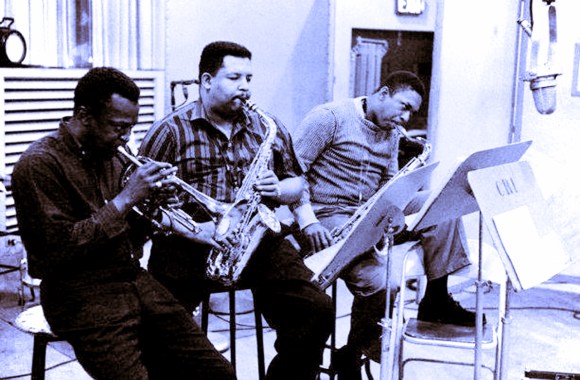
Miles, Cannonball and Trane recording Kind of Blue
The result is a cool, sometimes laid-back, sometimes rhythmic, sometimes groovy and boppish, but all together, a glorious album that more than 50 years later we can enjoy on a slow Sunday.
So here it is, “Somethin´Else” with the Cannonball Adderley Quintet featuring Miles Davis.
Fue en un momento difícil sin vueltas ni contratiempos que no fueran los contratiempos que nos llevaron a donde estábamos. Ese lugar desde donde era muy difícil salir más allá de nuestras buenas intenciones y de nuestra sensación constante de tener algo más para hacer con nuestras vidas que no fuese esto. -“Esto”- repetía la negra, – “Esto”- repetíamos los demás.
No había energía ni para buscar sinónimos ni para sonar más creativos o intelectuales de lo que éramos y lo que éramos era muy pobre comparado a lo que queríamos ser. -“Y si vamos a ver al topo que siempre tiene algo interesante para contar y entre tanto cuento que es en parte mentira en parte exageración y en parte verdades a medias tal vez se nos ocurra algo nuevo para hacer”- dije yo sin mucha convicción.
La verdad es que cualquier cosa era mejor que “esto” y con tal de irnos de acá y terminar en otro lado todo parecía ser mejor. Las vueltas de la vida nos había juntado como las migas de un mantel cuando viene el mozo con la palita y junta la miga de pan con el pedazo de milanesa con el papelito del edulcorante con una uña mordida y un par de pelos largos que pueden ser nuestros o de lo que estuvieron antes o del mismo mozo. Lo que nos unía no era amor, ni compasión, ni amistad ni nada que se le pareciera sino que lo que nos unía era el empujón que nos habían dado a todos para sacarnos de ahí y ponernos a todos juntos acá. Como las migas del mantel.
Finding my way back to you (detail) by IAB
No me pregunten por qué pero todos dijeron vamos a lo del topo y la negra arrancó primero conmigo atrás y claro atrás mío el vivo de Juancho que decía en voz baja -“vos siempre por atrás de la negra”-.
Confieso que me importaba todo poco. La negra era la negra pero no tenía nada de negra. Era peliroja cortita segura de sí misma e insegura de todos nosotros y por eso siempre tenía una copa de algo cerca ya que como no podía borronearnos a nosotros de su realidad se borroneaba ella. Y ahí estábamos, todos en camino a lo del topo.
Jack era el último de la fila india que formábamos indivisibles bajo el sol tajante y sonante de las 3 de la tarde en pleno verano de 35 grados y 80 de humedad y baldosas flojas y asfalto humeante y poca gente en la calle o mejor dicho nadie en la calle solo nosotros que con tal de salir de “esto” íbamos camino a lo del topo, aunque yo que era el que lo había propuesto ya me estaba arrepintiendo.
Jack tenía esas cosas tan típicas de los yanquis que los hacen simpáticos e incomprensibles a la vez como cuando están muertos por una minita como la negra y solo se atreven a traerles una cerveza y mirarlas fijo sin pestañear y escucharla con cara de tarado y una timidez espantosa y al mismo tiempo era el primero en falopearse como un cerdo dormir hasta cualquier hora sin bañarse por días y cantar a viva voz con un micrófono en mano en uno de esos barsuchos llenos de viejas que bailan y se quieren voltear pendejos que cantan con un micrófono en mano, eso sí después de estudiarlos a media luz en compañía de una ginebra como si eso fuese estudiar.
Dimos vuelta a la esquina y ya estábamos tocándole el timbre al topo que seguramente estaba durmiendo desde anoche y soñando con alguna de sus fabulaciones persecutorias que por lo general involucran canas, políticos, marcianitos verdes y algún animal que al final de la historia le habla y le dice algo profundo como… -”lo importante es crecer y no durar”-. –“Bajá!”- le gritaba la negra en el portero y solo se escuchaban la tos con algún insulto al aire y preguntas como quienes son ustedes para venir a joderme en el medio de un día así cuando nadie los llamo y quién dijo que yo los quiero ver ni escuchar por acá.
Todo seguido del -“Bueno suban pero no jodan demasiado”- y entonces ya sin ganas pero lejos de “eso” subimos….
“Reminiscencias de Kerouak” es un humilde homenaje al novelista. Escrito por mi como lo hacía él. Al vuelo, sin parar y en poco tiempo, respetando los sentidos y las cadencias, pero muy poco la puntuación formal. Pretende simplemente expresar mi admiración y ejemplificar un estilo único.
Espero que les haya gustado.
Jack Kerouak
Para los que no lo conocen, Kerouak es considerado el escritor más importante de la Generación Beat con varios de sus libros convertidos en lectura obligatoria para quienes desean comprender más esa época del siglo XX. Tanto “En el camino”, como “Los Vagabundos del Dharma” o “Los Subterráneos” se han convertido en novelas de culto para muchas generaciones.
El estilo de Kerouac se puede comparar con una improvisación del Jazz y particularmente del Bop, estilo que korouak amaba. En sus escritos hay repentización, creatividad y una aparente anarquía que está siempre a punto de perder al lector y que, sin embargo, termina atrapándolo como una compleja red.
El estilo de Kerouak no sigue reglas estables ni definidas, y se asemeja tal vez más a la conversación entre dos amigos algo pasados de alcohol, muy entrada la noche. Son siempre historias de “caminos”, de gente algo nómade, avanzando siempre hacia algún lado, complejas y absurdas a veces, pero festejando sin respiro todo lo grandioso de lo simplemente cotidiano.
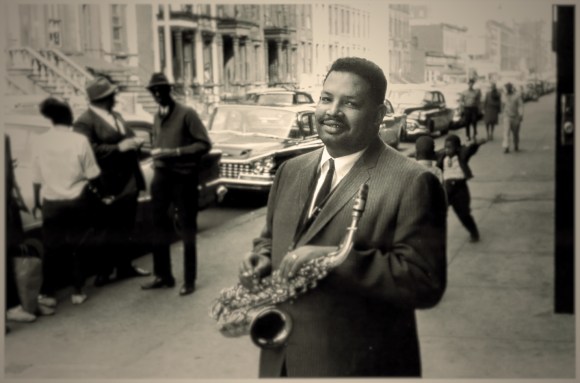
This is the first of my Sunday Articles dedicated to a Jazz Legend.
This Sunday, the first of the series, it is dedicated to a Bebop Legend: Mr Benny Golson.
Born on January 25th, 1929 (he is now age 87), Golson is a much loved (and many times forgotten by younger generations) hero of one of the most important eras of modern Jazz.
He was part of a bunch of musicians from Philadelphia who would in time change the way we saw Jazz. As a young kid he used to play with other promising musicians, people like the young John Coltrane, Red Garland, Jimmy Heath, Percy Heath, Philly Joe Jones, and Red Rodney (nice school friends to have if you ask me!).
After several bands straight out of college, he joined the “big leagues”, playing from 53 until 59 with Tadd Dameron, Lionel Hampton, Johnny Hodges, Earl Bostic, Dizzy Gillespie, and Art Blakey, with whom he recorded the classic Moanin’ in 1958.
In 1995 Golson received the NEA Jazz Masters Award of the National Endowment for the Arts. In October 2007 Golson accepted the Mellon Living Legend Legacy Award presented by the Mid Atlantic Arts Foundation at a ceremony at the Kennedy Center. Furthermore, during the same month, he won the University of Pittsburgh International Academy of Jazz Outstanding Lifetime Achievement Award at the university’s 37th Annual Jazz Concert in the Carnegie Music Hall. In November 2009, Benny was inducted into the International Academy of Jazz Hall of Fame during a performance at the University of Pittsburgh’s annual jazz seminar and concert.
So, after reviewing this “young man´s” incredible credentials, how about if we just get to it!
Here is the first of our Sunday Jazz concerts.
I invite you to simply enjoy the glorious music of Mr. Benny Golson.



 In biblical times, it was assumed that a person would die 40 days after he or she stopped breathing. The great Kings of Israel (Saul, David and Salomon) all reigned for forty years, Jonas preached for 40 days before Nineveh’s destruction, Noah’s great rains lasted 40 days and Moses received his call at 40 years of age and stayed in Sinai for 40 days. Furthermore, the chosen people lived in the desert for 40 years, while Jesus preached for 40 months, was tempted in the same desert by the devil for 40 days, disappeared from his burial place within 40 hours and appeared after resurrection, and before ascension, for exactly 40 days. And, obviously, forty days is the preparation time before Easter.

 returning from the horrowing experience free from pressures and erronous stimuli, feeling liberated and ready to resume the correct path.

 There isn´t much that can be said that has not already been said about Bill Evans.
 In what was described by long time friend Gene Lees as the “longest suicide in history”, Evans tragic life marked by great loses and drug abuse ended in 1980. Yet his mark was left for everyone to see and admire, and he is perceived as the main reformer of the harmonic language of jazz piano. He has influenced generations of brilliant pianists, including one of the best and most gifted of the current bunch, the great Brad Mehldau.


 This is the first of my Sunday Articles dedicated to a Jazz Legend.
 In 1995 Golson received the NEA Jazz Masters Award of the National Endowment for the Arts. In October 2007 Golson accepted the Mellon Living Legend Legacy Award presented by the Mid Atlantic Arts Foundation at a ceremony at the Kennedy Center. Furthermore, during the same month, he won the University of Pittsburgh International Academy of Jazz Outstanding Lifetime Achievement Award at the university’s 37th Annual Jazz Concert in the Carnegie Music Hall. In November 2009, Benny was inducted into the International Academy of Jazz Hall of Fame during a performance at the University of Pittsburgh’s annual jazz seminar and concert.
 IGNACIO ALPERIN: THE ART OF THINKING OUT LOUD / EL ARTE DE PENSAR EN VOZ ALTA