
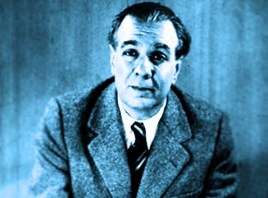
 Borges is one of Argentina´s great prides. The kind of author that forces everyone to say “Of course I´ve read Borges!” (be it true or not).
His friend and sometime collaborator, the also brilliant writer Adolfo Bioy Casares, called his texts “halfway houses between an essay and a story”.
Borges was not known as a great lover of music. He enjoyed classical music, and even tango as long as the “bandoneon” was not too prominent.
There is a lovely story about him going, invited by a friend, to watch a tango musician and composer whom everyone said was some kind of “boy wonder” of the new tango wave. One that borrowed a great deal from his New York upbringing and carried a very jazzy influence. His name was Astor Piazzola.
Borges apparently stayed for about six songs, and suddenly turned around, looked at his friend, and said: “Let´s go. Apparently they decided they were not going to play tango tonight”. Or so the story goes.
If you have never read him, recommended works by this very influential author (some have gone as far as to say that he may have been the XXth Century´s best writer: http://www.bbc.com/culture/story/20140902-the-20th-centurys-best-writer ) could be Ficciones (The Garden of Forking Paths, The Circular Ruins for example), Laberynth, The Aleph, and the earlier The Approach to Al-Mu’tasim (1938).
Borges is a bridge. A bridge between old and new, North and South, Classical and modern trends. In way he is also a bridge between Europe, Africa, Asia and the Americas. He is all about being new while rehashing what has already been done. Showing that what we create is more like what we “recreate”. His stories are wonderful to read, despite their inherent complexity, and they always feel new.
Clearly, he was also more open minded than many gave him credit for, since even after allegedly leaving Piazzola´s concert and despite his known dislike for the bandoneon, shortly after he went on to join forces with him in a project in 1965. From that wonderful coupling we have this beautiful song simply called: “El Tango”.

Until next time!
Ignacio

©2016 by Ignacio Alperin Bruvera











 In biblical times, it was assumed that a person would die 40 days after he or she stopped breathing. The great Kings of Israel (Saul, David and Salomon) all reigned for forty years, Jonas preached for 40 days before Nineveh’s destruction, Noah’s great rains lasted 40 days and Moses received his call at 40 years of age and stayed in Sinai for 40 days. Furthermore, the chosen people lived in the desert for 40 years, while Jesus preached for 40 months, was tempted in the same desert by the devil for 40 days, disappeared from his burial place within 40 hours and appeared after resurrection, and before ascension, for exactly 40 days. And, obviously, forty days is the preparation time before Easter.

 returning from the horrowing experience free from pressures and erronous stimuli, feeling liberated and ready to resume the correct path.

 There isn´t much that can be said that has not already been said about Bill Evans.
 In what was described by long time friend Gene Lees as the “longest suicide in history”, Evans tragic life marked by great loses and drug abuse ended in 1980. Yet his mark was left for everyone to see and admire, and he is perceived as the main reformer of the harmonic language of jazz piano. He has influenced generations of brilliant pianists, including one of the best and most gifted of the current bunch, the great Brad Mehldau.
 IGNACIO ALPERIN: THE ART OF THINKING OUT LOUD / EL ARTE DE PENSAR EN VOZ ALTA