Categories
2013 Art works 2013 Exhibitions Exhibitions IN ENGLISH Promoting your Art Videos Visual Jazz

An afternoon with Mr. Evans (and if it is in Paris, even better…)

billevanscoverBill Evans is one of those artists who are constantly present in my work.

This great piano genius was born in New Jersey, in 1929. He passed away in 1980 from health complications related to his hepatitis and his cocaine drug abuse, in what was described by a close colleague as “the longest suicide in history”.

At the height of his career, Evans was as emblematic to jazz and his instrument (piano) as Miles Davis was to the movement and trumpet playing.

He is seen as the main reformer of the harmonic language of jazz piano and was influenced by impressionist composers such as Debussy and Ravel. His versions of jazz standards, as well as his own compositions, always featured thorough changes to their original harmonies.  Musical features included added tone chords, modal inflections, unconventional substitutions, and modulations.

From Wikipedia:

Above is an example of Evans’s harmonies. The chords feature extensions like 9ths and 13ths, are laid around middle C, have smooth voice leading, and leave the root to the bassist. Bridge of the first chorus of Waltz for Debby (mm.33-36). From the homonymous album of 1961.

One of Evans’s distinctive harmonic traits is abandoning the inclusion of the root in his chords, leaving this work to the bassist, played on another beat of the measure, or just left implied. “If I am going to be sitting here playing roots, fifths and full voicings, the bass is relegated to a time machine.” This idea had already been explored by Ahmad Jamal, Erroll Garner, and Red Garland. In Evans’s system, the chord is expressed as a quality identity and a color. Most of Evans’s harmonies feature added note chords or quartal voicings.

Thus, Evans created a self-sufficient language for the left hand, a distinctive voicing, that allowed the transition from one chord to the next while hardly having to move the hand. With this technique, he created an effect of continuity in the central register of the piano. Laying around middle C, in this region the harmonic clusters sounded the clearest, and at the same time, left room for contrapunctal independence with the bass. Evans’s improvisations relied heavily in motivic development, either melodically or rhythmically.Motives may be broken and recombined to form melodies. Another characteristic of Evans’s style is rhythmic displacement. His melodic contours often describe arches.Other characteristics include sequenciation of melodies and transforming one motive into another.

Beyond his brilliance as a pianist and musician, and his technical excellence, Evans managed to imbue his music with a such warmth and melancholy that listening to him playing, even today, generates a deep emotional vibration.

This new work of mine, from 2013 and simply called “An afternoon with Mr. Evans” is one more of the many jazz and Evans inspired works in my own artistic repertoire.
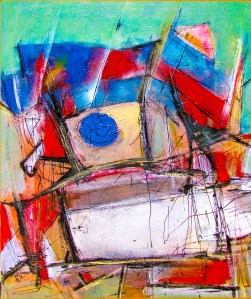
An afternoon with Mr. Evans_2013_50x65 b
AN AFTERNOON WITH MR. EVANS (2013), ACRILYC, INK AND OIL BASED PAINTS ON CANVAS, 50CM X 65CM, c Copyright 2013 Ignacio Alperin

I leave you while I hope you enjoy these next few minutes listening of this genius playing live in 1972 .

See you next time.

Ignacio

Awesome_1369282416164_edited1


©Copyright 2014 Ignacio Alperin


Categories
2008 art works 2009 art works 2010 art works 2011 art works 2011 Exhibitions 2012 art works 2013 Art works 2013 Exhibitions Design Exhibitions IN ENGLISH Visual Jazz

Ñ, that weird little letter which may well define the Spanish language, and its role in an undefined coffee table

logo enieThe most popular and competing Western languages in the world are English and Spanish.

For the Spanish speaker, the letter Ñ (roughly pronounced N-ee-A ) is like a symbol of this language´s uniqueness.

In Argentina, the top selling literature, arts and culture magazine, edited by CLARIN (the country´s most popular and largest selling newspaper) is properly called simply “Ñ”.

Yes, just a letter, but one that is the symbol of a whole language.IAB_PAG_6_Ñ_25MAYO2013

This magazine is published every Saturday and has average weekly sales of approximately 80,000 copies. Ñ, together with the LA NACION´s newspaper ADN (DNA in Spanish, and a different and perhaps more modern way of asserting where its cultural roots are), are the 2 most popular cultural magazines in the country.

I have been privileged enough to have been featured in both at different times, and it is always a proud moment when I can see my work reproduced in such prestigious and popular publications, and particularly when I find myself surrounded by articles on truly amazing local and international artists.

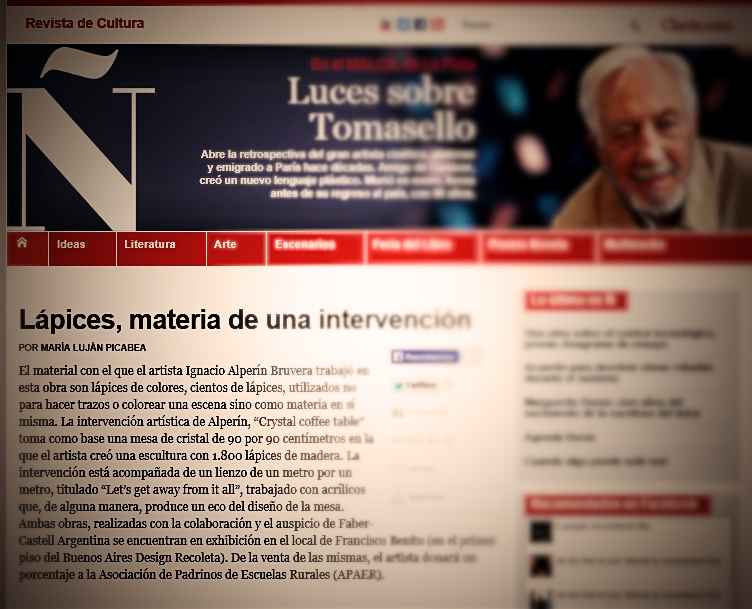
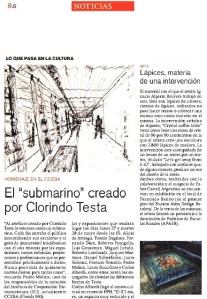
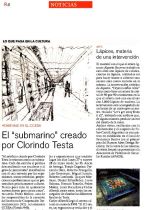
Last Saturday (May 25th ) I was surprised to find my latest intervention, and what has become so far this year´s one of my most popular works (my “Crystal coffee table with color pencils”), being featured on page 6.

renieIt is always fun to see how a writer approaches a piece of work. I still remember a short article in the same magazine a couple of years ago, in which a journalist with immense generosity, compared and intertwined my work in my “Visual Jazz Series” with Julio Cortazar´s writings and his love for Jazz (for an explanation of how my art and music are interconnected, and particularly Jazz, check out “Jazz means freedom” at http://wp.me/pN8b8-9s  ).

This time the reporter took a more clinical approach, which oddly enough I feel it is the right way to look at the piece.

First of all, because only a live viewing will reveal a certain depth and 3 dimensionality, that cannot be explained through a photograph. Secondly, because the piece is intriguing and that fuzziness is better left for the viewer to unravel, rather than subject it to an explanation that can only partially encompass all that it has to offer.

IAB_PAG6_Ñ_25MAY2013

And I can only invite you, if you can, to have a look at it live at the Buenos Aires Design Shopping Mall, where it will be on show for a little while longer. And if you can´t, do not worry, at the very least I have some great pictures from the great Fabian Cañás which I have published here previously and on Facebook for you to look at and enjoy. I hope you do.

Until the next time.

Ignacio

Clarin_20130528_ARQU10_4_4_F1

—————

Follow Ignacio on…

Twitter: www.twitter.com/ignacioalperin

Facebook: https://www.facebook.com/#!/pages/Contemporary-Artist-Ignacio-Alperin-Bruvera/147225685298260

Categories
2008 art works 2009 art works 2010 art works 2011 art works 2011 Exhibitions 2012 art works 2013 Art works 2013 Exhibitions Design Exhibitions IN ENGLISH Visual Jazz

ART, SUIT & TIE

As everyone who knows me  (www.ignacioalperin.com) knows, I am a maker of art and a lover of both art and music, particularly jazz and all its variations.

I have always endeavored to put both artistic forms of expression together, looking to synthesize them into new creations.iab_suit&tie

I have managed to do my own thing, but my love for the works of great geniouses like Kandinsky, Picasso, Van Koenig, Rauschenberg, and Pollock amongst others, will show through.

In music, even though my tastes are usually expressed in terms of the great bebop and hard bop masters like Evans, Coltrane, Monk, Davis, Pepper, Bird, and the golden era of American voices like Ella, Sinatra, Bennett, Dinah Washington, and Nina Simone, I am quite eclectic. I love classical music, tango, blues, soul, hip-hop and I can find inspiration in almost any tune that I enjoy, no matter its style.

Like I always say, music deserves a great deal of the credit in my art. “Inspiration is easy to find when you are perched on the shoulders of genius” is my usual response. 

As I slowly entered into the realm of object design and sculpture, music was also there to inspire me, to make me “see”.

IABCRYSTALTABLE2013-5

As many of you have seen, I recently introduced my latest piece at Art Deco, an Exhibition of intervened objects by well known Argentine artists, which took place at the Recoleta district in Buenos Aires in late April.

My design is quite simple. An all crystal coffee table within which, just like a transparent jewel box, In which I placed a sculptural piece made up of more than 1800 Faber-Castell Goldfaber artistic pencils standing perpendicularly and making up a colorful and airy version of the painting that lurches beneath.

 It strikes me that every person, whether young or old, who has stood in front of the finished table ends up drawing out a big and happy smile. The color pencils create a link to something very familiar, something warm within each one of us, and initiate the communication with the viewer immediately.

This slideshow requires JavaScript.

The idea of using pencils for this intervention came to me as I watched a Tony Bennett documentary a while back. I already had the crystal table and listening to that genius sing made me close my eyes, and suddenly I saw it. It was like a clear box full of candy, the idea of the beautiful color pencils used as objects d’art instead as of instruments was born. I know others have explored this avenue, but I think I have managed to make it both artistic and utilitarian, with a cool twist. I am happy with the results and with the reaction of the public. It has been a wonderful experience.

And to me, it is important that my art also has that COOL factor. It is a style and it is a message. Art is not something rigid, stuck somewhere in an impregnable limbo. It is something to be enjoyed. My art is a message of fredom and cool, for all to enjoy, in any way they wish to enjoy it.

And of course, preferably at home, after acquiring it!!!  🙂

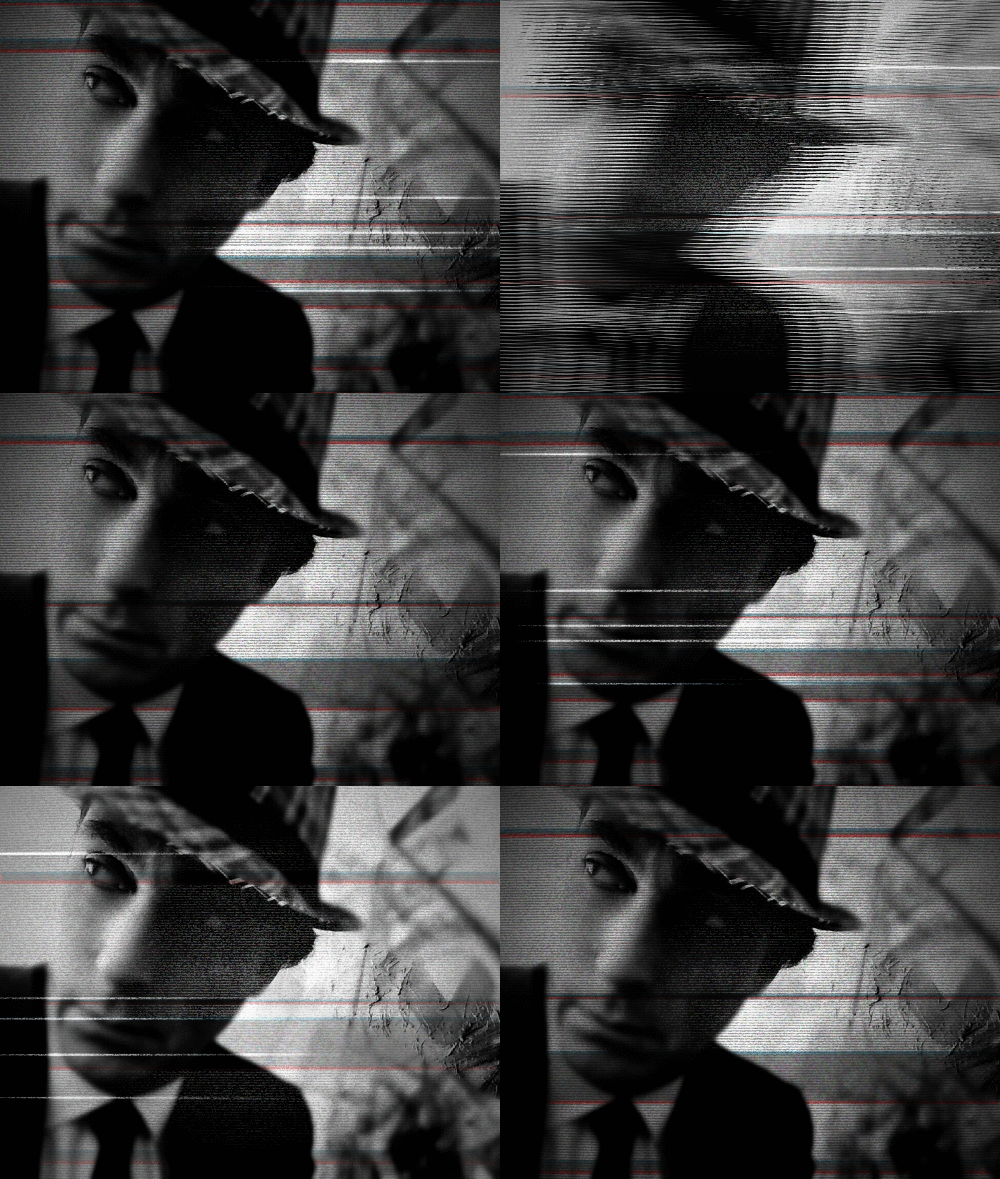
And talking about cool, enjoy the images of my latest work while you listen to  the new 60’s Jazz scene B&W video of Justin Timberlake’s latest (featuring Jay Z). It seems that JT, just like me, also likes doing his thing with a Suit & Tie.

Until the next time!

Ignacio

—————

Art and Design: Ignacio Alperin Bruvera 

Photos: Fabian Cañas.

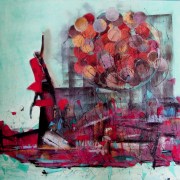
Painting accompanying the table in photos: “Let´s get away from it all” (2012) by Ignacio Alperin Bruvera, 100cm x 100cm.

Let´s get away from it all 100x100 (2012)

Follow Ignacio on…

Twitter: www.twitter.com/ignacioalperin

Facebook: https://www.facebook.com/#!/pages/Contemporary-Artist-Ignacio-Alperin-Bruvera/147225685298260

Categories
2012 art works 2012 Exhibitions Promoting your Art Visual Jazz What is Art

JAZZ MEANS FREEDOM

Many people ask me why I have chosen to base my current series on the sounds of Jazz.

There are many reasons. On the one hand, I simply love that sound. It can be simple or complex, uplifting or romantic, funky or full of swing, cool or pacific, but it always manages to delve somewhere deep and lift me up to places I didn’t know before.

Another reason is that Jazz for me is simply another way of saying freedom.  In jazz the score is just the excuse to show each musician’s luster and skills, as well as their love for sound that is rich, expressive and unique. Since its birth, this musical manifestation has been a part of all movements that wanted to articulate people’s liberty to express themselves.

And that is want I want to do on a canvas. I want to free myself to utter what is happening to me with the score, to allow me to be deceptively wild, to look for unorthodox ways of making you feel something different, and yet to allow you also the independence to see what I see in your own way, and in your own time and leisure.

There are many stories about the importance of Jazz in the fight for freedom. Not only musical but also as an expression of liberty of thought.

One of those well known stories involves the Benny Goodman Band and their first trip to the USSR in the 1950’s. Firstly, Mr. Goodman was incredibly surprised by the huge crowds which followed him in spite of one of the toughest environments for personal freedom in the second half of the XX Century.

Here was an American icon and his sound, allowed to play in Russia just as an excuse to show openness to the outside world, and at the same time people were not being allowed to listen to his kind of “foreign capitalist corrupt music”.

His second surprise was the fact that people came to him and kept telling him how they loved his work in terms of “we love CL7943 or CL8726”.

Goodman didn’t know what they were talking about. Until someone explained to him that because his works were prohibited by the government, people referred to them by their recording label number, as a way to avoid censorship and prohibition.

He thus found that, incredibly,  there were very few people as knowledgeable of all Jazz music as the Russian fans.

That in a small way was both a declaration of another triumph of the people to free themselves from an overbearing government, but also it was another triumph for Jazz music, a sound which after WWII became the music of freedom.

I don’t know if I can say that my art will one day represent as much, but I know that my aim is to make it a clear expression of the lack of restrictions I feel as I put my art across, of ideas reworked into shapes and colors without boundaries, of joy and pain and thought all intertwined into vivid and abstract melodies.

I don’t always manage to do it, but rest assured that with my Visual Jazz I am always looking for new ways to convey that improvised musicality, that different sound that strikes as offbeat first, but which with time simply becomes… just so cool.


Categories
2010 art works Promoting your Art

Artist of the Day in one of the Best Art Blogs around

I invite everyone interested in art to visit www.crimsonkaie.com, one of the best art blogs on the web and voted one of the best art blogs at Blogger.

Thank you Boyan for your support!

http://www.crimsonkaie.com/2010/11/ignacio-alperin-bruvera-buenos-aires.html

Categories
2010 art works Promoting your Art Videos Visual Jazz What is Art

MUSIC ON CANVAS 2

Categories
2010 art works Promoting your Art Videos Visual Jazz What is Art

New video online: An introduction to music on canvas

Categories
2010 art works Promoting your Art Videos Visual Jazz What is Art

New online video