A personal, curatorial & bilingual Blog about: Artistic Movements, my Art, Creativity, Innovation, Design, Leadership, Empowerment, Sustainability, Science, Jazz, Movies and other cool pursuits - Blog personal y curatorial bilingüe sobre: Movimentos Artísticos, mi Arte, Creatividad, Innovación, Diseño, Liderazgo, Empoderamiento, Sustentabilidad, Ciencia, Jazz, Películas y otros temas.
Originally released in early 1963, Monk’s Dream was the first Thelonious Monk album for Columbia Records.
Far from his late 40s early days of play, bop, and boomerang like throws of tempo and melody, by late 1962 his spirit had been broken.
Gone were also the days of his 50s Prestige Albums for which he felt he had had little recognition. Only in the period spanning 1958 to 1962 he was finally received as he felt he should. He was finally considered one of the preeminent figures in contemporary Jazz.
As a matter of fact, he also began recording this album in 1962, and it was released months later in 1963.
Columbia was then the home of Brubeck and Davis, and Monk filled the spot for this trio of sorts for a label building a mark around what was new with jazz.
Monk´s dream is also my panting.
50cmx50cm, acrylic, inks and oil based paints on canvas. Painted in 2015, it expresses the volatility of Monk´s playing, his hot a cold moments, his ups and downs like some cartoon mountain range, his almost mad cap presence, and the difficulty of those around him to keep up with his inventive as well as happy, almost exuberant, playing.
Monk´s Dream was the last of the great Monk, and it became also the best selling album of his career. He topped it only in 1964 when he was in the prestigious cover of Time Magazine with an article called “The loneliest Man”.
Even though he kept playing and releasing albums until 1971, he was no longer the same that had dazzled beatnicks and jazz lovers alike for almost two decades. His unclearly diagnosed mental illness was becoming more of an issue in his life, causing paying and anguish to everyone around him.
He sadly passed away in 1982, at the relatively young age of 64.
Then you have come to the right place, because this Sunday Concert is dedicated to Cannonball Adderley and his famous album from 1958, “Somethin´ Else”.
Cannonball Adderley gave up his own band in 1957 on the hope, and later realization, that he was going to be a part of Jazz history when Miles Davis asked him to become sideman in Davis’ epic ensemble with John Coltrane, and eventually Bill Evans.
The result? Some “forgettable” works like Milestones and Kind of Blue..
Miles Davis returned the favor and in March of 1958, he appeared on Adderley´s Blue Note Album “Somethin´ Else”, appearing as his sideman in an all star quintet session date.
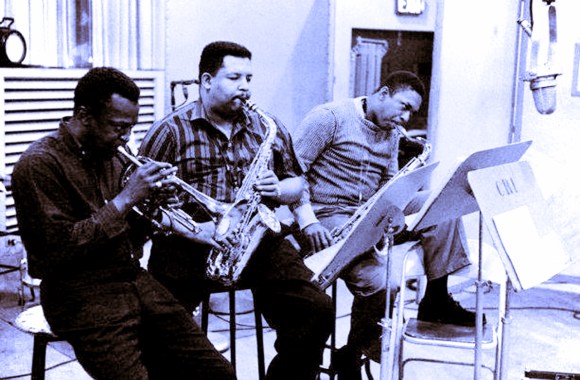
Miles, Cannonball and Trane recording Kind of Blue
The result is a cool, sometimes laid-back, sometimes rhythmic, sometimes groovy and boppish, but all together, a glorious album that more than 50 years later we can enjoy on a slow Sunday.
So here it is, “Somethin´Else” with the Cannonball Adderley Quintet featuring Miles Davis.
Fue en un momento difícil sin vueltas ni contratiempos que no fueran los contratiempos que nos llevaron a donde estábamos. Ese lugar desde donde era muy difícil salir más allá de nuestras buenas intenciones y de nuestra sensación constante de tener algo más para hacer con nuestras vidas que no fuese esto. -“Esto”- repetía la negra, – “Esto”- repetíamos los demás.
No había energía ni para buscar sinónimos ni para sonar más creativos o intelectuales de lo que éramos y lo que éramos era muy pobre comparado a lo que queríamos ser. -“Y si vamos a ver al topo que siempre tiene algo interesante para contar y entre tanto cuento que es en parte mentira en parte exageración y en parte verdades a medias tal vez se nos ocurra algo nuevo para hacer”- dije yo sin mucha convicción.
La verdad es que cualquier cosa era mejor que “esto” y con tal de irnos de acá y terminar en otro lado todo parecía ser mejor. Las vueltas de la vida nos había juntado como las migas de un mantel cuando viene el mozo con la palita y junta la miga de pan con el pedazo de milanesa con el papelito del edulcorante con una uña mordida y un par de pelos largos que pueden ser nuestros o de lo que estuvieron antes o del mismo mozo. Lo que nos unía no era amor, ni compasión, ni amistad ni nada que se le pareciera sino que lo que nos unía era el empujón que nos habían dado a todos para sacarnos de ahí y ponernos a todos juntos acá. Como las migas del mantel.
Finding my way back to you (detail) by IAB
No me pregunten por qué pero todos dijeron vamos a lo del topo y la negra arrancó primero conmigo atrás y claro atrás mío el vivo de Juancho que decía en voz baja -“vos siempre por atrás de la negra”-.
Confieso que me importaba todo poco. La negra era la negra pero no tenía nada de negra. Era peliroja cortita segura de sí misma e insegura de todos nosotros y por eso siempre tenía una copa de algo cerca ya que como no podía borronearnos a nosotros de su realidad se borroneaba ella. Y ahí estábamos, todos en camino a lo del topo.
Jack era el último de la fila india que formábamos indivisibles bajo el sol tajante y sonante de las 3 de la tarde en pleno verano de 35 grados y 80 de humedad y baldosas flojas y asfalto humeante y poca gente en la calle o mejor dicho nadie en la calle solo nosotros que con tal de salir de “esto” íbamos camino a lo del topo, aunque yo que era el que lo había propuesto ya me estaba arrepintiendo.
Jack tenía esas cosas tan típicas de los yanquis que los hacen simpáticos e incomprensibles a la vez como cuando están muertos por una minita como la negra y solo se atreven a traerles una cerveza y mirarlas fijo sin pestañear y escucharla con cara de tarado y una timidez espantosa y al mismo tiempo era el primero en falopearse como un cerdo dormir hasta cualquier hora sin bañarse por días y cantar a viva voz con un micrófono en mano en uno de esos barsuchos llenos de viejas que bailan y se quieren voltear pendejos que cantan con un micrófono en mano, eso sí después de estudiarlos a media luz en compañía de una ginebra como si eso fuese estudiar.
Dimos vuelta a la esquina y ya estábamos tocándole el timbre al topo que seguramente estaba durmiendo desde anoche y soñando con alguna de sus fabulaciones persecutorias que por lo general involucran canas, políticos, marcianitos verdes y algún animal que al final de la historia le habla y le dice algo profundo como… -”lo importante es crecer y no durar”-. –“Bajá!”- le gritaba la negra en el portero y solo se escuchaban la tos con algún insulto al aire y preguntas como quienes son ustedes para venir a joderme en el medio de un día así cuando nadie los llamo y quién dijo que yo los quiero ver ni escuchar por acá.
Todo seguido del -“Bueno suban pero no jodan demasiado”- y entonces ya sin ganas pero lejos de “eso” subimos….
“Reminiscencias de Kerouak” es un humilde homenaje al novelista. Escrito por mi como lo hacía él. Al vuelo, sin parar y en poco tiempo, respetando los sentidos y las cadencias, pero muy poco la puntuación formal. Pretende simplemente expresar mi admiración y ejemplificar un estilo único.
Espero que les haya gustado.
Jack Kerouak
Para los que no lo conocen, Kerouak es considerado el escritor más importante de la Generación Beat con varios de sus libros convertidos en lectura obligatoria para quienes desean comprender más esa época del siglo XX. Tanto “En el camino”, como “Los Vagabundos del Dharma” o “Los Subterráneos” se han convertido en novelas de culto para muchas generaciones.
El estilo de Kerouac se puede comparar con una improvisación del Jazz y particularmente del Bop, estilo que korouak amaba. En sus escritos hay repentización, creatividad y una aparente anarquía que está siempre a punto de perder al lector y que, sin embargo, termina atrapándolo como una compleja red.
El estilo de Kerouak no sigue reglas estables ni definidas, y se asemeja tal vez más a la conversación entre dos amigos algo pasados de alcohol, muy entrada la noche. Son siempre historias de “caminos”, de gente algo nómade, avanzando siempre hacia algún lado, complejas y absurdas a veces, pero festejando sin respiro todo lo grandioso de lo simplemente cotidiano.
There is an old movie called Galaxy Quest, about a group of actors who, having enjoyed better days (professionally and in their personal lives), still perform together occasionally at Mall Openings and conventions. Their common bond is the fact that, long ago, they all starred in a successful TV Sci-fi show (of the same name as the title).
The movie has its moments, particularly at the start when they are kidnapped by an alien race and get embroiled in the middle of a war with a planet of lizards. It is a simple case of mistaken identity.
It seems that the aliens picked-up the TV signals in space and thought that the crappy TV show episodes were in fact historical documents about a group of invincible warriors who saved planets from extinction, while in fact we know they were a bunch of semi-retired second rate actors doing weekly shows in front of cardboard sets.
This movie always comes to mind, not because it is anything outstanding, but because almost every time I give a lecture about creativity or art I get asked by professionals, artists and university students alike, about what are in my mind the most important aspects that help in building a successful career.
Success is many things to many people, and I am not going to try to define it here. Suffice to say that I am assuming that we are talking about attaining some of what we search in life (it may be recognition, love, a family, money, power, a career, and so on).
Furthermore, I am in favor of defining success and failure in every aspect of our lives if we wish, and as we wish. In my case, I let others run races set by someone else. I run my own.
THE QUESTION IS: WHAT IS SUCCESS TO YOU?
And that may be the first point. You are the master of your own life. You set your destination, and it is up to you to decide how you wish to go about it. I am a great believer that the power of “we” is far superior to the power of “me”, but I have to know where I am going before I can invite others to tag along, or join up with others in their journey.
Many concepts can be added on from there – creativity, solidarity, positive thinking, conscience, ethics, hard work, intelligence, responsibility, self-discipline, clairvoyance of sorts, and so on -, but there is one that is a must. One which to me is so important that it may help to bring you over the other side even when you lack some of those qualities.
In “Galaxy Quest” they keep repeating the catch phrase of the show, which happens to be “Never give up! Never surrender!”. In fact the whole movie is based on this very premise. Not giving up and not surrendering (no matter how ridiculous, scary, or ridiculously scary the situation may be). What they are talking about is nothing more than “resilience”.
Merrian-Webster defines the concept of resilience in general as “the capability of a strained body to recover its size and shape after deformation caused especially by compressive stress”.
That, translated to a human capacity, refers to a quality that allows some people to absorb pressure and failure, and convert it into something positive. The old fashion “taking on the knocks and coming back stronger than ever” attitude.
Some people innately have this quality. Yet for others, it is a matter of learning. Psychologists have identified some of the factors that will categorize someone as resilient.
The most common seems to be optimism. It does not mean blindness to reality. It just means having a positive attitude even after being burned down. It means doing a Phoenix like flip and rising from the ashes. It means taking on apparent failure and turning it into a lesson on the way to success. It makes people capable of adapting intelligently and quickly to change, adjusting their outlook promptly and soldiering on.
Resilience is at the essence of very successful people (whether they are at the top of the corporate heap or are just a great mum or dad). It is what keeps us going our way when everyone else is also telling us to go, but away.
Sometimes, hitting the proverbial wall has to do with schemas, pre-formatted ideas people have about how things “should” be (many companies also have them and they show up, for example, when seeking new personnel). Sometimes there are other issues and we should always revise our own attitudes as well (it is not a matter of simply placing blame somewhere else either).
But that adaptability, resistance, aptitude and attitude is what allows us to take in responses from others that feel, very often, like a slap in the face and comeback with the best scorecard we have ever done. It means jumping over, letting go by, or simply ignoring the negatives along the way so we can make it to where we want to go.
One great example of this was recently given by Jack Ma. He said: “I failed 3 times in college. I applied 30 times to get a job but I have always been rejected. When KFC came to China for the first time, we were 24 to apply and I was the only one to be dismissed. I wanted to go into the police and out of 5 postulants, I was the only one not to be accepted. I applied 10 times to return to Harvard and I was rejected. Never give up because you failed once, twice…just understand that failure is only how we are shown another way to reach our intended route”.
Just in case you don´t know, Jack Ma is the founder of Alibaba, which together with Amazon are the two largest e-commerce websites in the world. He is also the 22nd richest person in the world with $29.8 billion dollars, according to Forbes.
So…just never give up, never surrender. Learn, adapt, spring back, and find your way to your own kind of success.
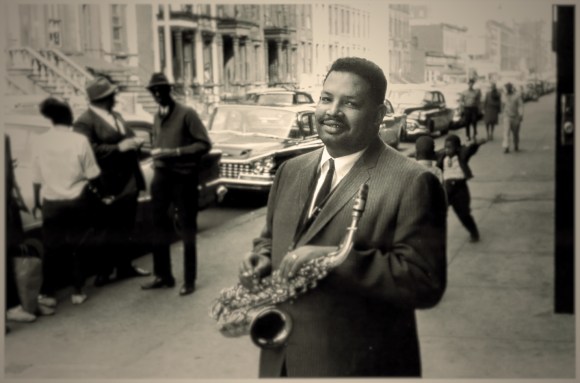
This is the first of my Sunday Articles dedicated to a Jazz Legend.
This Sunday, the first of the series, it is dedicated to a Bebop Legend: Mr Benny Golson.
Born on January 25th, 1929 (he is now age 87), Golson is a much loved (and many times forgotten by younger generations) hero of one of the most important eras of modern Jazz.
He was part of a bunch of musicians from Philadelphia who would in time change the way we saw Jazz. As a young kid he used to play with other promising musicians, people like the young John Coltrane, Red Garland, Jimmy Heath, Percy Heath, Philly Joe Jones, and Red Rodney (nice school friends to have if you ask me!).
After several bands straight out of college, he joined the “big leagues”, playing from 53 until 59 with Tadd Dameron, Lionel Hampton, Johnny Hodges, Earl Bostic, Dizzy Gillespie, and Art Blakey, with whom he recorded the classic Moanin’ in 1958.
In 1995 Golson received the NEA Jazz Masters Award of the National Endowment for the Arts. In October 2007 Golson accepted the Mellon Living Legend Legacy Award presented by the Mid Atlantic Arts Foundation at a ceremony at the Kennedy Center. Furthermore, during the same month, he won the University of Pittsburgh International Academy of Jazz Outstanding Lifetime Achievement Award at the university’s 37th Annual Jazz Concert in the Carnegie Music Hall. In November 2009, Benny was inducted into the International Academy of Jazz Hall of Fame during a performance at the University of Pittsburgh’s annual jazz seminar and concert.
So, after reviewing this “young man´s” incredible credentials, how about if we just get to it!
Here is the first of our Sunday Jazz concerts.
I invite you to simply enjoy the glorious music of Mr. Benny Golson.
Formas (pronounced for-mass) in Spanish means “shapes”, but it can also mean “manners” in the way our parents kept telling us to have better manners, and it can also mean “ways”, as in different ways of doing something.
My art encompasses the three.
I solidly work on shapes, I try to find good manners of executing and presenting my art to others, and I am always searching for new ways to do what I do.
The end result…well, the opinion on the end result I leave up to you.
In this case, it has to do with the music of Argentine “Bandoneon” maestro Dino Saluzzi.
In his 2006 album “Senderos” (ECM) with Jon Christensen, Formas is de second last song.
Written by Saluzzi and Christensen, it reminds us more and more of the great Astor Piazzola. Less jazzy in its context, but still investigative and climatic, his music transcends tango into other frontiers of sound.
So here is this brilliant álbum, and the painting inspired by “Formas”. Almost 10 years after the song saw the light of day as an important part of this inspired album.
Ganador de 9 Grammy Awards y considerado una de los músicos más influyentes del Siglo XX, Miles Dewey Davis III (más conocido como Miles Davis, o simplemente “Miles”) continúa aún hoy, décadas después de su muerte, ejerciendo su influencia en ámbitos propios y ajenos.
Desde médicos investigadores de la Universidad John Hopkins, a diseñadores de la D-School de la Universidad de Stanford, la música de Davis, y su trabajo en cuartetos y quintetos basados en una alta dosis de brillante inspiración y, por sobre todas las cosas, de perfecta improvisación, genera estudios y teorías sobre las neurociencias y su aplicación en áreas creativas.
Como artista plástico, la música de Miles me ha acompañado desde los 12 años, edad en que descubrí sus dotes casi “mágicos”. Durante muchos años ignoraba que una parte de mis dones creativos se debían a una sinestesia aplicada a mi obra. Mi ignorancia temporal, igualmente marcada por una certeza creativa, le dieron entonces al Jazz, y particularmente a Davis y sus contemporáneos como Evans, Coltrane, Monk, Hawkins, Jamal, Brubeck, Basie, Roach, y Clark (solo por nombrar a algunos) una faceta inspiradora y un poder milagroso sobre mi arte.
Sobre los hombros de estos genios musicales yo sentía que mis propias creaciones se alzaban hacia alturas insospechadas. Con el tiempo supe que mi interpretación sinestésica le daba una explicación más “terrenal” a mi característico uso pictórico de movimientos, ritmos, cadencias, y explosiones tonales. Pero el tiempo también me dio la razón sobre el aspecto inspirador de la música de Davis y su influencia sobre quienes la escuchamos con amor y admiración.
Hoy en día el ojo de las ciencias está puesto sobre las creaciones de estos genios de la música que lograron utilizar sus poderes y procesos creativos de una manera poco vista hasta entonces. Su obra nos enseña, tal vez particularmente hoy en día que estamos finalmente comprendiendo el funcionamiento de nuestros cerebros de manera más concreta, que nuestras capacidades pueden ser entrenadas para improvisar grupalmente, para trabajar en equipo de manera ordenada, fluida, y natural. Y esos procesos pueden tener, a la vez, la intimidad sensorial así como la explosión grupal de un tema de Davis.
Mi obra hoy sigue volando sobre las alas de estos genios creativos. Mi “Visual Jazz”, como lo bautizara una periodista norteamericana, sigue plasmando sobre lienzos, maderas, objetos y estructuras las cadencias y los ritmos de un estilo de Jazz que me continúa guiando y exigiendo, y por ello agradezco cada día. Un Jazz que, a la vez, ha pasado a convertirse en uno de los legados culturales más importantes que nos ha dejado el Siglo XX.
Y sobre todo, sigo agradeciendo al único y genial Miles, por haberse atrevido a mostrarnos el camino desde siempre.
“Blue in Green” is the third tune on Miles Davis’ 1959 album, Kind of Blue. One of two ballads on the LP. (the other being “Flamenco Sketches“).
As an aside here (and something that may earn you points in one of those “did you know?” kind of games), it has been said that the second ballad which appears on the record as “Flamenco Sketches” is in fact the song “All Blues” and vice versa. Yes, the argument is that somebody may have switched them by mistake and that they only realized it when the records were already printed and so were the covers, and as a result one simply became the other.
At the very least this is what Jeremy Yudkin argues (also as an aside point) in his scholarly article Miles Davis Kind of Blue, which you can read on the Oxford University Press Music Quarterly Journal. He correctly points out that “Flamenco Sketches” fits more logically with the strumming mid-tempo of the song which appears as “All Blues”, while the title “All Blues” fits much better with the last, very slow song that is known as “Flamenco Sketches” (If you ask me, the easiest thing would be to simply check the original copyright registry of both scores…but no one is asking me…I know).
In any case, the spirit behind “That other day” is a little bit more complex, and less romantic, than “That Day”.
One of the most beautiful songs in that masterpiece album is “Blue in Green“, with its mainly modal melody. Recorded on March 2nd, 1959, in New York City, and in the same session where “So what” – another classic – was also recorded, it was the result of combining the talents of some of the best musicians of its time: Julian “Cannonball” Adderley, Miles Davis, Jimmy Cobb, Bill Evans on piano, and Paul Chambers on bass.
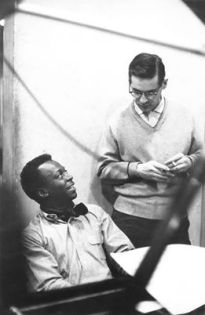
Even though the song appeared in the original record as written by Davis, it has long been speculated that pianist Bill Evans had, at the very least, a hand in it (the credits for the Evan´s trio Album “Portrait in Jazz”, in which there is a version of “Blue in Green”, attribute the song to ´Davis-Evans´)
Some go as far as to say that Evans actually wrote it. This is the case of producer Earl Zindar, whom in the Fall 1993 issue of a magazine called Letter from Evans , said that he knew perfectly well that Evans had actually penned it himself. He said “I know that it is [100-percent Bill (Evan)’s] because he wrote it over at my pad where I was staying in East Harlem, 5th floor walkup, and he stayed until 3 o’clock in the morning playing these six bars over and over.”
On the opposite side of the street we find Miles Davis asserting, in his autobiography, that he alone composed all the songs on Kind of Blue. Confirming this is the writer and poet Quincy Troupe, co-author of one of the best know Davis biographies -, who said in an interview and in regards to this issue:
“Miles talked about being back in Arkansas, and he was walking home from church. And the people in the backwoods were playing these really bad, really great gospels. He couldn’t see the people but he heard these gospels coming in through the trees and over the trees. And it was dark and he was about six years old, and he was walking with his cousin. So he said that gospel, and that music, and also he had been listening to the music from the Guinean Ballet, the finger piano, so all of that fused and came back to him with this feeling that he heard playing when he was walking through the back roads of Arkansas.
And he started remembering what that music sounded like and felt like. He said that feeling was what I was trying to get close to in Kind of Blue. That feeling had got in my creative blood, my imagination, and I had forgotten it was there. I wrote these blues to try to get back to that feeling I had when I was six years old, walking with my cousin down that dark, Arkansas road.”
The end result is that, sadly, we will never know the whole truth. Over the last 20 years the song appears mostly now as a “Davis-Evans” composition. It is sometimes difficult to know what goes on in the mind of brilliantly creative people to get stuck, at one point, over something like this and never settle the issue. I guess, it is that exception that everyone talks about when reaffirming a certain opposite rule.
The issue became so heated between both musicians that Zindar himself, in another interview conducted by Win Hinkle, recalled the 1978 Evans NPR interview in which he asserts his authorship of the song, and recalls –with certain humor and disdain – writing to Miles with the suggestion that he should be entitled to a percentage of royalties, to which Miles apparently responded with an envelope that had a check for twenty-five dollars in it.
I am no musician, but I can distinctly see Evans hand in this. Miles was also a wizard, so doubts persist. I guess the best way to go about it is to just enjoy their brilliance and accept that for once, these two geniuses showed their flaws and pettiness for all of us to see. An exceptional blemish for two men who had dazzling musical careers that no one can refute or argue with.
Here is my pictorial version of “That Other Day”. That nonetheless beautiful day – the music still moves us the same way it did before – but it is also the day in which these two egos collided. More complex than the original painting, but maintaining its spirit and stressing the superposed opinions of Bill and Miles.

 Originally released in early 1963, Monk’s Dream was the first Thelonious Monk album for Columbia Records.





 college. I applied 30 times to get a job but I have always been rejected. When KFC came to China for the first time, we were 24 to apply and I was the only one to be dismissed. I wanted to go into the police and out of 5 postulants, I was the only one not to be accepted. I applied 10 times to return to Harvard and I was rejected. Never give up because you failed once, twice…just understand that failure is only how we are shown another way to reach our intended route”.

 This is the first of my Sunday Articles dedicated to a Jazz Legend.
 In 1995 Golson received the NEA Jazz Masters Award of the National Endowment for the Arts. In October 2007 Golson accepted the Mellon Living Legend Legacy Award presented by the Mid Atlantic Arts Foundation at a ceremony at the Kennedy Center. Furthermore, during the same month, he won the University of Pittsburgh International Academy of Jazz Outstanding Lifetime Achievement Award at the university’s 37th Annual Jazz Concert in the Carnegie Music Hall. In November 2009, Benny was inducted into the International Academy of Jazz Hall of Fame during a performance at the University of Pittsburgh’s annual jazz seminar and concert.
 Formas (pronounced for-mass) in Spanish means “shapes”, but it can also mean “manners” in the way our parents kept telling us to have better manners, and it can also mean “ways”, as in different ways of doing something.
 Until next time.
 Ganador de 9 Grammy Awards y considerado una de los músicos más influyentes del Siglo XX, Miles Dewey Davis III (más conocido como Miles Davis, o simplemente “Miles”) continúa aún hoy, décadas después de su muerte, ejerciendo su influencia en ámbitos propios y ajenos.
 que descubrí sus dotes casi “mágicos”. Durante muchos años ignoraba que una parte de mis dones creativos se debían a una sinestesia aplicada a mi obra. Mi ignorancia temporal, igualmente marcada por una certeza creativa, le dieron entonces al Jazz, y particularmente a Davis y sus contemporáneos como Evans, Coltrane, Monk, Hawkins, Jamal, Brubeck, Basie, Roach, y Clark (solo por nombrar a algunos) una faceta inspiradora y un poder milagroso sobre mi arte.

 On the opposite side of the street we find Miles Davis asserting, in his autobiography, that he alone composed all the songs on Kind of Blue. Confirming this is the writer and poet Quincy Troupe, co-author of one of the best know Davis biographies -, who said in an interview and in regards to this issue:

 IGNACIO ALPERIN: THE ART OF THINKING OUT LOUD / EL ARTE DE PENSAR EN VOZ ALTA