A personal, curatorial & bilingual Blog about: Artistic Movements, my Art, Creativity, Innovation, Design, Leadership, Empowerment, Sustainability, Science, Jazz, Movies and other cool pursuits - Blog personal y curatorial bilingüe sobre: Movimentos Artísticos, mi Arte, Creatividad, Innovación, Diseño, Liderazgo, Empoderamiento, Sustentabilidad, Ciencia, Jazz, Películas y otros temas.
EXPLORANDO EL DON CREATIVO EN WINE&ART (BUENOS AIRES, ARGENTINA)
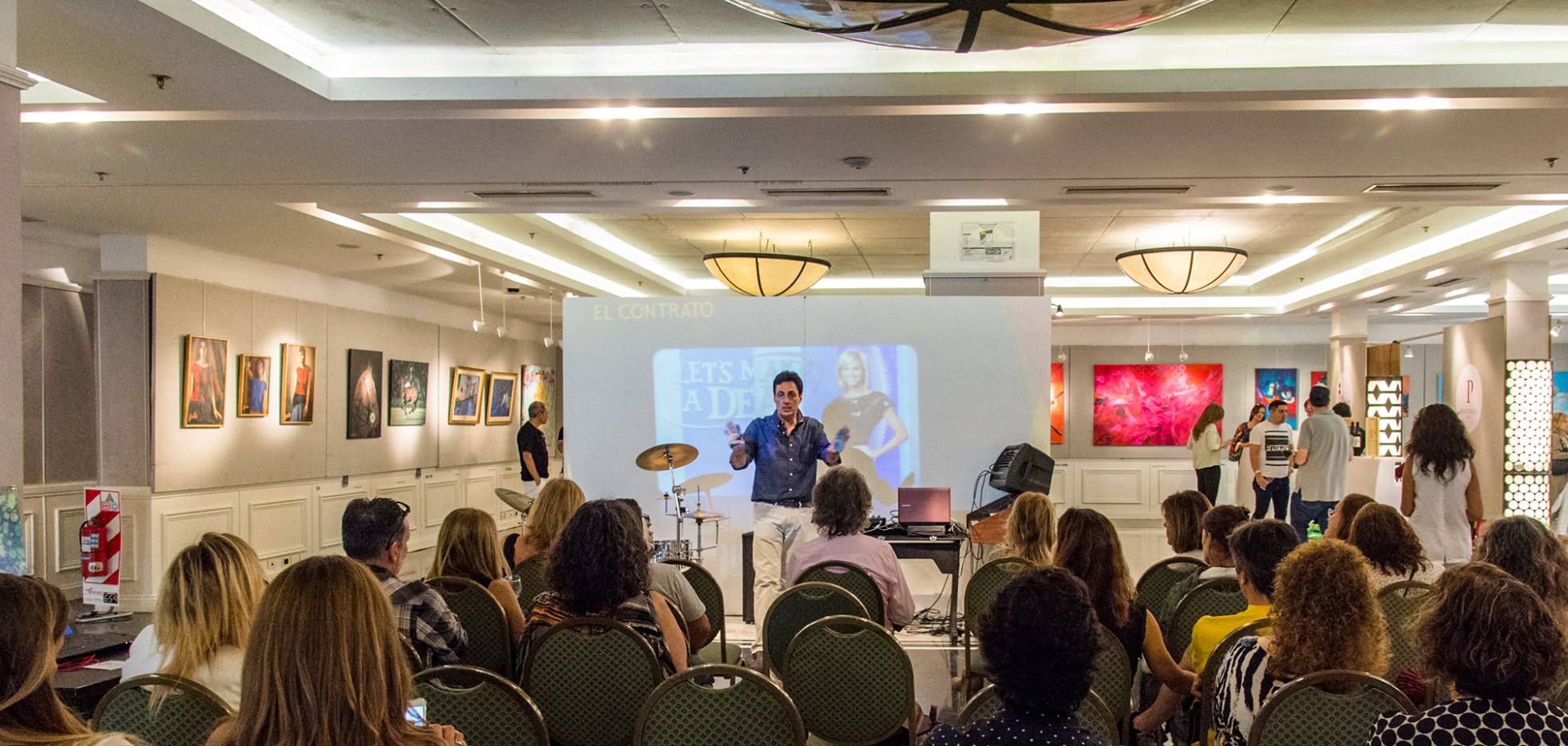
En Abril fui invitado, una vez más, por la incansable y gentil Ligia Janeiro, factotum de ArtWork Eventos de Arte, para participar de una nueva edición de Wine&ART, la expo de arte que realiza todos los años en los muy lindos salones del Hipódromo Argentino de Palermo.
Durante dos días seguidos realizamos 2 conferencias sobre creatividad, innovación, el proceso artístico, el marketing artístico y el mercado del arte.
Agradezco enormemente a todos los artistas que se acercaron a disfrutar de un momento juntos tanto el sábado 1 como el domingo 2 de Abril.
Allí también tuvo el gusto de presentar una nueva obra (IT NEVER ENTERED MY MIND) y de encontrarme con gente muy interesante que se acercó a Wine&ART atraídos por la constante y excelente oferta artística.
This March I had the pleasure of receiving an invitation to give one of my Creativity Lectures at Hodges University, in the beautiful City of Naples, Florida.
Hodges is a relatively young University which is growing with giant steps.
Sponsored by the Naples Arts Association, and coordinated by Professors Aysegul Timur and William M. Gritz, we spent close to 2 hours exploring some basic (and not so basic concepts) of the creative process. From the neurological to the practical, we had a very interesting time with a varied audience which included University Staff and students, as well as writers, artists and sculptors from the Naples area.
Thank you to Professors Gritz and Timur, to the Executive Director of the NAA, Aimee Scheler, and to everyone involved for the opportunity to exchange ideas and experiences.
It is striking to see how most people, no matter where they live and how different their cultures may be, looking for answers to the same issues and, more or less, in the same places. It is perhaps, as Bill Evans used to say, the Universal Mind of man that takes us all towards similar goals.
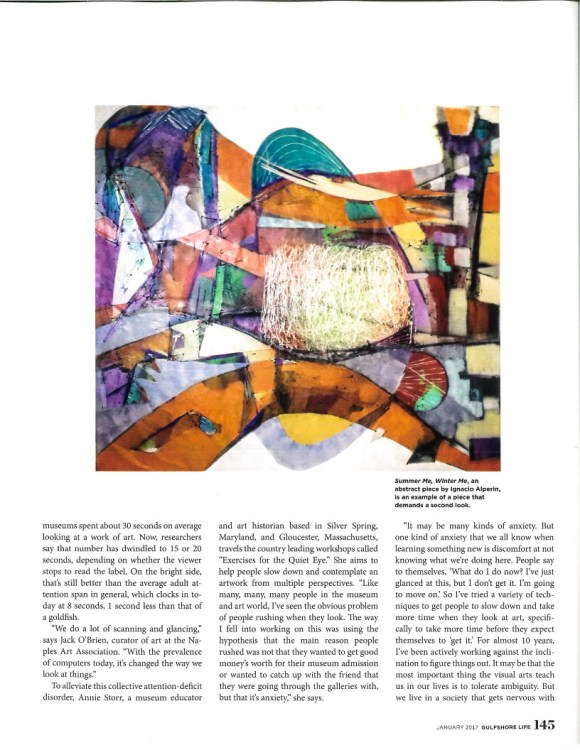
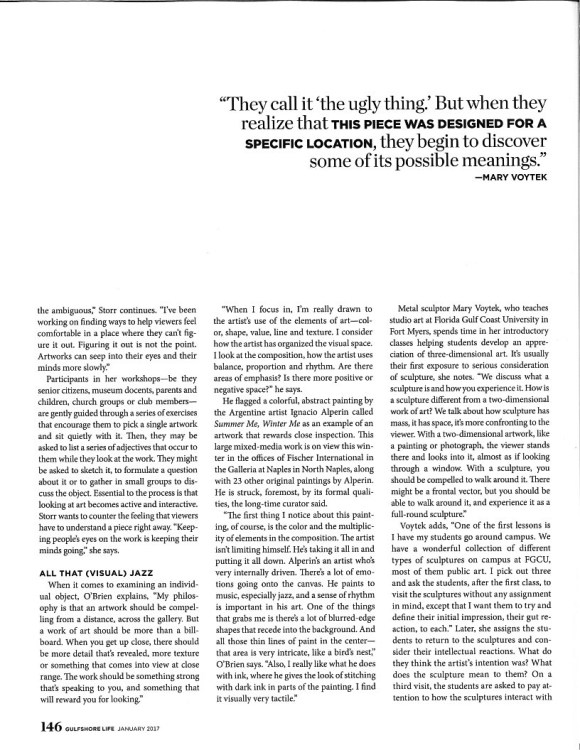
REVISTA GULSHORE LIFE, Enero de 2017. Artículo/Review sobre la mirada creativa. Una de las 3 obras seleccionadas para analizar es “Summer me, Winter me”, obra que realizara en 2015. Espero que lo disfruten. Muy agradecido a Gulfshore Life Magazine y al curador Jack O´Brien por la enorme gentileza.
GULFSHORE LIFE MAGAZINE, JANUARY 2017. Article/Review about viewing art creatively. One of the 3 pieces selected for the article is my painting “Summer me, Winter me” from 2015. I hope you enjoy it. And a big thank you to Gulfshore Magazine and curator Jack O´Brien for the comments and the inclusion in the Magazine (which I am proud to say is my 4th in less than year!)
We usually talk respectfully about “talented” individuals, companies look for “new talent”, while the media reviews and applauds “talented” performers. Some of us may have even dreamt -or may still hope- to be in consideration for that label. And why not? It would seem people openly considered as “talented” have the world at their feet. But what is really talent? Or at least, what qualifies as talent in these situations? Furthermore, is there such a thing as a “talented individual”?
Merriam-Webster defines talent, in this particular usage, as “1. archaic : a characteristic feature, aptitude, or disposition of a person or animal, 2. the natural endowments of a person; and 3. a special often athletic, creative, or artistic aptitude or b : general intelligence or mental power : ability.”
The first obvious thought that comes to mind from looking at the definition, is that it is a very misused word. Clearly, it is one of those expressions in common usage that has become a generic term in itself. And just as for most people around the world the name Coke is a generic term (a definition in itself) as much as a brand, the everyday use of the brand Talentgenerates a common and accepted image no matter whether we are talking about sports, business, science, or a spelling bee competition.
Yet, moving beyond the superficial -and maybe misleading- use of the specific term, it remains so that “talent” is not something as special as one may have been led to believe. Quite the contrary, having talents seems to be as much an intrinsic part of an individual as, let’s say, being creative, having body organs or breathing.
The fact is that we all have received talents from the word go. They are our natural endowments, using the description of Merriam-Webster. They can be both our genetic (family), and personal (individual) gifts. Capacities that make up as much of who we are as any other personal characteristic. It is the stuff we are good at, as well as the things we suspect we could be good at if we gave it a serious try, those we suspect are there but we need to give ourselves the opportunity -and time- to explore them, and even those which are hidden from us and we don´t even know exist.
In the same way as it used to be said that only some people were talented, the same happened with creative people. These days we can say – backed by strong neurological and psychological evidence, as well as with at least 100 years of relevant scientific research-, that in fact, “we are all creative”. What we are not is all “the same creative”. In a way, and in reference to “talent”, the same thing seems to apply.
So, what makes some people raise above others then? How come we generally recognize that, even if we are all talented, some may seem to be more so than others (following Orwell´s Animal Farm line of thought that “we are all equal, but some are more equal than others” perhaps). And what makes them more noticeable than the rest?
There are clearly common qualities that spread across the different professions and which can be analyzed. In simple terms, an approximation to the “Famous Talents” Top 10 checklistcould look a bit like this:
Most of them put in the work. There is hard labor behind all that “talent”. 8 hours a day is just for suckers.
They study a lot. These are not lazy people touched by a magic wand. They usually need to know much more than what they need to use. These people are encyclopedic, even if sometimes only in very specific areas.
They don´t mind emulating. Everything is -more or less- a remix. They know it, and they are all out to learn from the best.
They produce the goods. Others with similar talents may be just waiting for that lucky break. These people are all about getting the breaks by producing, and producing, and producing…
They are “out there” (in a wide mode or in a subject specific mode, but out there). They work their marketing tools to the hilt. They are socially active and, if applicable, also on social media. They love followers and search for more. They know they were lucky to get into the spotlight, but they also know that for luck to find them, they had to work hard and be visible.
They know when they are onto a good thing. Repetition makes perfect so they all have their war horses and ride them to the end.
There is an “aura” about them. Whether purposely or naturally, most of them will pursue nonchalant, detached, and understated manners and ways that make other people feel in the presence of “some kind of intellectual/sporting/artistic/(you name it) royalty”. Others will go for the opposite -loud and annoying- effect, and even if successful, the other “talents” will see them as simple “flashes in effect ridden pans”.
They are extremely demanding, of themselves and of others. You were just complaining about a boyfriend/girlfriend? If you think they are demanding, it’s because you have seen nothing yet. These people wrote the book!
They are markedly creative and feed their creative instincts constantly. Noticeably talented individuals are noticeably creative individuals. And they always let you know about it.
They are all thinking about the day after. Not the day after the project, the movie, the book, or the election. They are all thinking about the day after they die. Their drive is rocketed by the hope of achieving some type of relative immortality. They are working hard at getting their permanent stamp on their specific world, and this is a driving force that pushes them quite a few extra miles.
So, on the one hand, talent is everywhere (in human and animal terms and without exception). In our specific case, wherever there is a human being (and today with 7 billion plus on the planet, that is almost everywhere) there is talent, obvious or latent. But also in society, there are those who clearly will go the extra distance and be lucky enough to be noticed, be formally labelled, and get the benefits from being openly considered as “a Talent”.
Whether we are looking to reboot our natural talents, or to either retain or hire what is commonly referred to as “new talent”, it is very possible that many of these 10 qualities we just mentioned are expected to be found (they are obviously not the only ones). So, it may be a smart move to look at the manner in which many of these people work and act. Emulating them, working hard, liberating our creative spirits, and remixing a little, may then get us a long way.
Un hecho que nunca deja de sorprenderme en los muchos años que llevo dando clases, talleres y charlas sobre liderazgo, creatividad, innovación y sobre la creación artística en particular, es la cantidad de gente que, habiendo pagado, o al menos invertido el tiempo en asistir a un seminario, transita la mayor parte de ese tiempo compartido haciendo… otra cosa.
Hoy en día lo más común es chatear por celular, pero puede ser también trabajar en la computadora (convencidos que esa “escucha en segundo plano” es idéntica a la participación formal), o simplemente demostrar que no están interesados poniendo aburridas caras de “esto ya lo sé”.
La verdad sea dicha, nunca me he dado por vencido con ninguno, y puedo señalar con cierto orgullo que la gran mayoría de ellos han salido estimulados por el intercambio de ideas y experiencias que finalmente se produce.
Pero la realidad indica también que ese hecho no es casual y que se origina ante la conjunción de una serie de elementos que lleva a personas, aparentemente interesadas en un tema en particular, a actuar de manera indiferente. Y esto no se limita a un curso, seminario, o actividad universitaria. En términos más generales también pasa en nuestra vida cotidiana. Desde una reunión de negocios hasta la charla técnica entre amigos antes del partido de fútbol, es una constante que siempre haya quienes, por diferentes motivos, miren todo “desde afuera”.
Las razones pueden ser muchas. En pos de la obtención de mejores resultados, y porque si sabemos lo que estamos haciendo tenemos muchas mejores posibilidades de resolver positivamente el tema en cuestión, les propongo que analicemos al menos 5 de las razones más comunes que yo he encontrado en mis seminarios, y que pueden llevar a una persona a desaprovechar su inversión en tiempo y dinero, o a encerrarse y perder oportunidades de adquirir nuevas destrezas laborales, sociales o emocionales:
Vinimos a escuchar lo que queremos escuchar.
Es un hecho que a todos nos cuesta escuchar lo que nos dicen y la tendencia natural es a querer que nos digan lo que queremos escuchar. Nuestros egos son difíciles de manejar, y más si estamos en posiciones de mando en una organización o somos profesionales independientes, acostumbrados a dar directivas y no a recibirlas. Intuitivamente nuestra necesidad -y satisfacción- es la de tener razón más que la de encontrar la verdad, y eso se refleja en nuestras actitudes. A tal punto que es muy común rodearse de gente que nos diga siempre que sí. Para realmente abrirnos y aprender, es importante escuchar de verdad.
Esto, en algún lado, ya lo vi.
Aunque nos cueste admitirlo, todos tenemos una vocecita que nos habla. No estamos locos, es un recurso muy normal. Pero lo peor que nos puede pasar es que la voz interior nos convenza que no hay nada nuevo en lo que estamos viendo. La realidad indica que todo proceso creativo es un remixado de ideas y posiciones ya existentes, modificado por nuestras experiencias personales, y en donde se pueden agregar elementos diversos. Es una recomposición de conceptos que genera algo novedoso. Y por lo tanto, es probable que muchas cosas nos traigan a la memoria otros conceptos parecidos que hemos visto en algún lado. La recomendación es la de no escuchar a la vocecita que nos pide que cerremos la cabeza. Démosle una oportunidad a lo que estamos recibiendo, y muy posiblemente nos sorprendamos con el resultado.
Yo, yo, y yo.
En este mundo del Siglo XXI en el que el “yoismo” hace estragos, enfrentarnos con un proceso que requiere hablar más de “nosotros” y menos de “mi” claramente cuesta. Muchos cursos y libros sobre creatividad e innovación parecen hoy más compendios de autoayuda que enseñanzas sobre lo que implica verdaderamente el proceso creativo. Al menos como yo lo veo, y contrariamente a lo que se presume comúnmente, no es un proceso basado en una mente brillante y díscola que logra romper con el statu quo. Muy por el contrario, es un proceso grupal, casi comunitario, que incorpora enseñanzas ya existentes, las reconstituye, y genera nuevas propuestas con la participación de varios actores trabajando mancomunadamente (lo que no implica que se lleven bien, solo que sepan trabajar juntos). El aceptar que no se trata de “cómo hago yo, para estar mejor yo, para tener una mejor vida yo, y para ser exitoso yo” y que en cambio tiene más que ver con “cómo podemos hacer nosotros, para estar mejor nosotros, para generar ideas y propuestas que nos involucren a todos por el beneficio de muchos” es ya un buen comienzo.
Yo escucho, pero no sé si lo entiendo o si me cierra. Después de todo, yo llegué hasta aquí sin necesidad de todo esto.
Para muchos la necesidad de ser más creativos, y por ende más flexibles, es una simple moda. Que desde la empresa, o el entorno laboral, le pidan -o incluso le obliguen- a hacer un taller sobre temas como estos les genera rechazo. Muchos se preguntan “¿Por qué cambiar? Encima yo no me considero una persona creativa”. Sin embargo, la realidad nos indica que todos somos creativos, y que canalizar esas destrezas de una manera más metódica en un mundo de paradigmas en constante flujo, nos permite optimizar lo que hacemos. Como no nos queda opción, nuestra “vocecita interior” nos termina convenciendo que dejemos de resistir y que simplemente escuchemos – así terminamos de una buena vez!-. Pero con escuchar solamente, nos quedamos a mitad de camino y por ende, el resultado puede no ser satisfactorio. Eso nos llevará a sentir que lo que recibimos no nos sirve y que es todo una pérdida de tiempo. El proceso de enseñanza pone sobre la mesa información. Esa información disponible debe ser absorbida. No hay absorción sin participación. Por eso, escuchar no basta, y contribuir es esencial para generar el cambio.
Ya soy una persona grande. No voy a hacer eso.
El proceso creativo tiene en su centro una visión más lúdica de las cosas. Uno de los propósitos de mis seminarios y talleres es lograr que recuperemos “el niño interior”. Esa mirada inocente y despejada de vergüenzas, mandatos familiares, y temores es el camino más directo a reencontrarnos con nuestras capacidades perdidas. La resistencia, que en general es un temor “al qué dirán”, no nos permite participar. Para no sentirnos excluidos preferimos mirar lo que ocurre con ojos críticos, y el resultado final es muy poco enriquecedor. Somos grandes y podemos jugar, podemos reírnos, podemos participar, y podemos hacer el ridículo. Eso no nos convierte en personas “poco serias” (aunque en algún nivel espero que sí), si no que nos convierte en personas más completas y preparadas a explorar y explotar todas nuestras capacidades (las innatas, las estudiadas y las aprendidas casualmente a lo largo de nuestras vidas). Eso nos va a ayudar a ser personas menos frustradas, más creativas e innovadoras, demostrando liderazgos más naturales, y seguramente nos ayudará a ser también personas más completas, y por lo tanto, más felices.
Whenever I give a creativity lecture at University, or in artist´s or corporate workshops or talks, I always commence by asking everyone if they would not mind signing an agreement with me before we start. Nothing legal, mind you. But all important when it comes to preparing the ground before we seed it with fresh concepts, or with new interpretations of old ones.
The agreement basically asks everyone to accept that, for the duration of our time together, they will pay no attention to their “inner voices”.
Some people look at me with surprise, as if hearing voices was something more related to being a little crazy than overly sane. Sooner or later, they all smile shyly as most finally admit that they all hear them (and most, to their dismay, even have full “conversations” with their alter egos).
The fact remains that, even if many of us will deny it, we all do hear voices and converse with them. They may not be like “good Homer & evil Homer” (which by the way, as many things in the Simpsons, is a take on the Flintstone´s and the “saintly Fred / evil Fred” of decades ago), but they nevertheless engage us into inner conversations about what to do, how we feel, or about the way we should react to everyday dilemmas as they compare, and weigh-in, the different possible scenarios.
This slideshow requires JavaScript.
While they are mostly helpful, these voices can sometimes work against us.
That is because what we usually refer to as “original thought”, is in fact mostly a remix of existing information and knowledge, plus perhaps a new take on it (many times based on our own personal experiences), or perhaps a different engagement, calculation or approach, or a combination into one of what were -until now- separate avenues of development. It is a fact that whenever one hears about a “new” idea or theory, it will resonate somehow as most of us, at some point, have either heard, seen, or read something similar, or related to it -factual or as an exercise of the imagination-.
That is the time when the little voice becomes an issue. It tells you “Oh yes! I saw that on Discovery Channel last year”, or “I read something about this in such and such review”. In other words, “This is old news”.
We feel energized by this fact because our egos love “knowing” before others, but the ensuing feeling of apparent superiority becomes dangerous. Because as a result, you may also turn off your attention from whatever you are being exposed to as “I already know what this is” (or at least you become convinced that you do) and there is no point wasting your time with it.
Every bit of information that comes your way after that moment just “bounces” of your brain into infinity. And the whole exercise simply becomes a lost opportunity to open up your mind and explore something different, something creative, and something that may ultimately move you forward (or sideways, or at least definitely somewhere else than where you are).
I could go on. But one of the most important lessons to take away from all of this should be that it is always better -much better in fact- to listen, even argue, with others rather than just discuss things with yourself. I am not denying that introspection is also part of the process, and there is always a time for it as well. But everything has a place and a role to fulfill. Without others our conclusions will be simply poorer, less empathic, and less sustainable in the long run.
Next time you are entering a creative process of your own and people try to give you their opinions or information, just press “mute” in your head, and make an effort to look and listen to everything that is being put in front of you as openly as you can, almost like in the way a child looks at something that he or she has just discovered.
The truth is that every individual view of one same event is slightly different. Our brain is the filter between “reality” (which is no more than a perception of whatever is “out there”) and who we are. Each brain is a unique sift, and everybody´s views will enrich a result. They will definitely make it better and different -and perhaps they will even make it unique, or help you make it unique-.
So whenever you are presented with something that may be new, and “the voice” begins to play havoc, try to follow this little guide:
Stay in May, as the traditional Art Naples World Festival is now known, is a magnificent example of a comunity getting together to show and involve the general public in the best that the Arts have to offer.
I was very lucky to take part in this year´s event through the invitation of the Naples Art Association and the Festival organizers, and I must say I was impressed by the quality, the care and the variety that this group of hard working individuals have managed to put together year after year.
Just in case you have not seen any of my previous videos, here is a compilation from the Festivals own collection of promotional shorts.
Enjoy (and consider Naples in May for your next vacation! It is very much worth your while!)
Thanks to the gracious invitation by the CRYSTAL BRIDGES MUSEUM OF AMERICAN ART, I participated in the inauguration of their new exhibition by painting live at the Museum Amphitheater on May 11th, 2016.
I am very grateful for the invitation and the opportunity to visit this incredible new American Museum.
Here are some images from the event, in which I had the pleasure of painting to the music of a great band, Crusades.
CRYSTAL BRIDGES MUSEUM OF AMERICAN ART
For those who don´t know this beautiful and exciting modern American Museum, here is a little introduction:
Alice Walton, the daughter of Walmart founder Sam Walton, spearheaded the Walton Family Foundation’s involvement in developing Crystal Bridges. The museum’s glass-and-wood design by architect Moshe Safdie and engineer Buro Happold features a series of pavilions nestled around two creek-fed ponds. The complex includes 217,000 square feet (20,200 m2) of galleries, several meeting and classroom spaces, a library, a sculpture garden, a gift shop designed by architect Marlon Blackwell, a restaurant and coffee bar.
Don Bacigalupi was appointed director of the museum in August 2009. In early May 2011, the museum announced three endowments by the Walton Family Foundation totaling $800 million. These endowments were established for operating expenses, acquisitions and capital improvements.
Notable works include a Charles Willson Peale portrait of George Washington as well as paintings by George Bellows, Jasper Cropsey, Asher Durand, Thomas Eakins, Marsden Hartley, Winslow Homer, Eastman Johnson, Charles Bird King, John LaFarge, Stuart Davis, Romare Bearden, Norman Rockwell, Mary McCleary, Agnes Pelton, Walton Ford, Chuck Close, Jasper Johns, Alfred Maurer, Jackson Pollock and Tom Wesselman.





 In the same way as it used to be said that only some people were talented, the same happened with creative people. These days we can say – backed by strong neurological and psychological evidence, as well as with at least 100 years of relevant scientific research-, that in fact, “we are all creative”. What we are not is all “the same creative”. In a way, and in reference to “talent”, the same thing seems to apply.

 Un hecho que nunca deja de sorprenderme en los muchos años que llevo dando clases, talleres y charlas sobre liderazgo, creatividad, innovación y sobre la creación artística en particular, es la cantidad de gente que, habiendo pagado, o al menos invertido el tiempo en asistir a un seminario, transita la mayor parte de ese tiempo compartido haciendo… otra cosa.
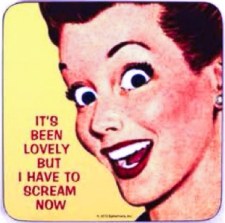 Pero la realidad indica también que ese hecho no es casual y que se origina ante la conjunción de una serie de elementos que lleva a personas, aparentemente interesadas en un tema en particular, a actuar de manera indiferente. Y esto no se limita a un curso, seminario, o actividad universitaria. En términos más generales también pasa en nuestra vida cotidiana. Desde una reunión de negocios hasta la charla técnica entre amigos antes del partido de fútbol, es una constante que siempre haya quienes, por diferentes motivos, miren todo “desde afuera”.




 Stay in May, as the traditional Art Naples World Festival is now known, is a magnificent example of a comunity getting together to show and involve the general public in the best that the Arts have to offer.


 IGNACIO ALPERIN: THE ART OF THINKING OUT LOUD / EL ARTE DE PENSAR EN VOZ ALTA