A personal, curatorial & bilingual Blog about: Artistic Movements, my Art, Creativity, Innovation, Design, Leadership, Empowerment, Sustainability, Science, Jazz, Movies and other cool pursuits - Blog personal y curatorial bilingüe sobre: Movimentos Artísticos, mi Arte, Creatividad, Innovación, Diseño, Liderazgo, Empoderamiento, Sustentabilidad, Ciencia, Jazz, Películas y otros temas.
El Universo entero es producto de un proceso de creación y modificación constante.
Mientras que nuestra civilización siempre ha intentado, de alguna manera u otra, ejercer – o aparentar ejercer- el control sobre la naturaleza y el universo mismo, la experiencia nos enfrenta con una realidad algo diferente.
TIME REMEMBERED (2015) by Ignacio Alperin
Nuestra propia existencia como raza humana ha dependido siempre de una serie de eventos que obedecen en parte a lo que generen nuestras propias acciones, y en una importante proporción a una serie de eventos absolutamente fortuitos.
Dentro de lo que denominamos eventos fortuitos, algunos se producirán dentro de los ecosistemas familiares, profesionales y comerciales que nosotros mismos generemos, mientras otros tendrán que ver con hechos relacionados a las acciones de otros, y en la mayoría de los casos, al funcionamiento del universo mismo.
Nuestra supervivencia global e individual se basa en gran medida, entonces, en nuestra propia adaptabilidad y creatividad en cada momento de nuestras vidas, y en cómo compartimos ese aprendizaje a lo largo y ancho de las generaciones.
Aunque no nos percibamos como seres creativos y especulemos con que, alternativamente, sí hay personas específicamente creativas que han heredado genéticamente ese don, la realidad nos indica lo contrario.
Dizzy & Duke
Mientras es innegable que hay gente diferente, tanto en lo relacionado a ciertas vocaciones individuales, como a genialidades esporádicas que sí pueden obedecer a características excepcionales, y también como producto de rasgos heredados, ya sea genéticamente o a través de mandatos familiares o sociales; es igualmente cierto que todos sin excepción tenemos la capacidad de, intuitivamente de base y constructivamente a través del aprendizaje y la comprensión, ser creativos miembros de la sociedad y de utilizar esa creatividad más allá de nuestro ámbito personal y familiar.
Fragmento de Creativos en la era de la creatividad
Arte y Jazz – Algunos Conceptos y Propuestas (Tercera Revisión)
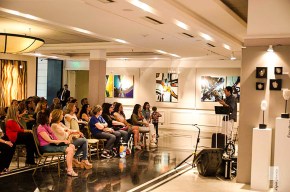
Hacia fines de 2015 tuve la fortuna de participar del evento Wine & Art, en el marco de la semana Buenos Aires Deli & Polo en el Hipódromo Argentino de Palermo.
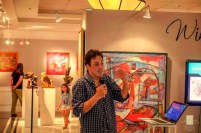
Organizado por Art Work, con la gentil, creativa y esmerada Ligia Janeiro a la cabeza, fui invitado a presentar , en versión acotada, uno de de mis ya clásicos seminarios titulados “The Crash Flash Boom Creative Afternoon”.
Con una nutrida concurrencia de artistas y creativos, dedicamos un poco más de dos horas a indagar el por qué de estos procesos, y a comprender que podemos domarlos, alejándonos de lo imprevisto y de lo fortuito, convirtiéndolos así en nuestras armas de uso intensivo.
Quiero agradecer nuevamente a todos los que se acercaron, a los que tuvieron palabras muy generosas para conmigo, a todo el personal de Art Work, y particularmente a Ligia Janeiro por su generosidad y excelente buena onda.
(English)
At the end of 2015 I was generously invited to the event “Wine & Art”, held within the Buenos Aires Deli & Polo week, at the posh Palermo Racetrack in Buenos Aires.
Organized by Art Work, with Ligia Janeiro at the helm, I was invited to present one of my “The Crash, Flash Boom, Creative afternoon” seminars (in a shorter 2 hour version).
I had a wonderful time, and I was very flattered by the participation of some many artists and creatives, for the kind words afterwards, and for Ligia´s kind invitation and superb energy and care.
Creativity does not have to be something untamed. If we understand how it works and the mental processes that make it up, we can leave behind the “fortuitous event of the creative flash” and use simple tools to get our creative reasoning and thinking to work to our own benefit, in a concerted effort with others, while capitalizing on all of its potential.
Murray Gell-Mann is an American physicist. A friend and colleague of Albert Einstein, he received the 1969 Nobel Prize in physics for his work on the theory of elementary particles.
He is now 86 and still going strong. He is obviously famous for his scientific studies and most importantly, he is basically known as the father of the “Quark”, which is the name he gave to a minute particle which is a fundamental building block of neutrons and protons, and which he found has very unusual properties.
He also loves delving in other subjects such as linguistics, archeology, and he even expands his views and opinions on the subject of creativity and innovation. During my seminars at the University I draw a great deal of inspiration from some of his very clever ideas. First and foremost, the fact that the Universe is one, and we are part of it. And as part of such a large event, we follow necessarily certain rules that are common to everything that exists within it.
Gell-Mann is not alone. It is not uncommon to hear physicists or mathematicians – even Stephen Hawking, Albert Einstein, Sir Issac Newton before them, and even Aristotle way before all of us – refer to the beauty, simplicity or elegance of equations or theorems and how these characteristics tend to be a good omen that a correct formula is close by (Newton said, for example, that “Nature is pleased with simplicity” while Aristotle made a point in favor of simplicity by advocating as few as possible postulates).
Gell-Mann always tells the story about his 1957 theory on the weak force which he and his colleagues decided to publish. They did so even though it went against seven well know experiments which said something very different. According to him, they did it because they obviously thought they were correct, but the indication that this was so was just the fact that, to them, their answer was a simple one while the other, which was the accepted reasoning, was convoluted and ugly. In time it was shown that Gell-Mann and his friends were correct and all known experiments at the time were wrong.
I always tell my students that simplicity is at the core of all successful enterprises, while overly complex concepts tend to have a much lower success rate, and in the case of initial success, relatively low survival rate. By simplicity I also mean organic, natural, intuitive.
A common example for this, believe it or not, is Facebook.
The core architecture of Facebook is so simple that it almost shocks those who sit down to analyze it for the first time.
I don´t know if it is still going on, but a well-known fact happening at Facebook for a long time was that on the first day of work at the company, the VP of Product, Chris Cox, would give newcomers a remarkable introductory talk. In it he would focus, amongst other things, on explaining Facebook´s product architecture and how it relates to the mission of the company.
When we talk about a company´s architecture, we mean the building blocks of a company, its structure, and how these objects relate to each other and with each other.
Cox, moved by great minimalistic aptitude, describes it in the case of Facebook, as a directory of people, their friends, and their interests; plus a directory of businesses, from global brands all the way to small local businesses. Plus, on top of those directories, a thorough map which basically shows the relationships that exist between all those things. That´s it. No more or less. And that summarizes Facebook.
And it can´t be denied that it is a crystal clear formulation of the product, directly relevant to the mission the company has set, and above all, easily understood by anyone who sees it. It is “beautiful”, it is “elegant”, it is in line – within the corporate cosmos – with Albert Einstein’s famous remark about the fact that he had faith in that “the principle of the universe will be beautiful and simple.”
As far as company´s architectures go, it is beautifully simple, and it is organic to the extent that it is following our everyday interactions, which occur naturally in society, and in doing so it is also helping us to make them richer.
Now, to the big question. Is then the claim that beautiful and elegant answers, as proclaimed by scientists and partially concurred by many who deal in many diverse professions – including myself -, factual evidence or there may be more mundane explanations for this? Does apparent simplicity explain itself or does it hide something else within the underlying structure of reality? Or can it simply be explained by way of sociological, psychological or practical considerations?
Just from the above enumeration of possibilities one gets the distinct notion that things are not that “simple” in “simple answers”.
For a start, it is important to notice that the aesthetics of equations is quite deceiving. An answer may not be convoluted in terms of steps or length because many symbols, which make it look short and “elegant”, involve within their meaning, long and complex equations. What is hidden in all derivative operations is nothing less that long and complex definitions. Thus the “appearance” of simplicity may hide great deal of complexity, and it usually does.
But does this vitiate the argument that “simplicity and elegance” is a good sign in regards to proper and workable solutions?
While mathematicians compress very complex ideas in easily understood symbols, life itself does a bit of the same.
When I say someone is “good”, as opposed to someone who is “evil”, what am I really saying? The concept of “good” requires of a long, and usually difficult to agree, definition. Many philosophers and theologians have spent their lives looking for a formal demarcation without definite agreement. Yet it is one of the most used words, and therefore concepts, in any language.
What has happened is that common consensus has looked to “simplify” its meaning. It is probably an acceptable explanation that a good man
A commonly accepted “Good Man” (as well as “nice & jolly”)
tends to be the sum of the specific interactions between the idea of a person who (generally speaking) does not act against his fellow men, with one who (mostly) acts in a responsible manner, and one who has a certain degree of solidarity, honesty, and social conscience. May also involve concepts such as being a respected and loving father, brother, son, husband, or friend. And so on.
The definition involves a series of terms which act in the same manner as arithmetical “derivatives”, and when put together, they come up with a symbolic word which makes a very intricate but widely acceptable concept into something “simple and elegant”.
The same can be said of anything. Our day to day life involves a constant oversimplification of complex concepts. The oversimplification factor can overlook many nuances but it also makes concepts easily understood and shared by all, and sharing is one of the key factors which make a society into a healthy and growing civilization.
So is simplicity merely the expression that intricate concepts acquire when consensus generates a commonly agreed, albeit limited, explanation? Everything seems to be pointing that way. A flower is a flower but depending on the level of complexity I wish to analyze it, it is a flower or it is something so complex that only a molecular physicist, biologist and botanist can muster.
If it is then a matter of socially acceptable definitions? Can then simplicity be merely described in sociological terms? Is it just a mirage in a wide desert of concepts as abundant as grains of sand? The answer may be resting somewhere in between.
In the same way that the concept of the Universe can be explained in fairly simple and elegant terms, it can also be described as the most complex conjunction of situations, equations, “random coincidences”, and an uncertain prequel and origin we have been able not to ever explain at this time.
Simple answers thus generally hide extremely complex definitions, equations or layered responses which no longer need to be probed as their terms are generally accepted, or because the general description is acceptable on its own terms even if one sees or intuits that a more complex situation lies beneath the surface.
“Simplicity and elegance” may be then a matter of communicating the commonly accepted “look and feel” of something in a terminology that is understood by most at a specific period of time.
As an artist I see this in my own work, and an example of this may be a good way of making graphic something that by now seems so philosophical.
The general perception of a painting may hide a complex underlying theme or pictorial development. Take for example Epistrophy, my painting from 2015.
“Epistrophy” (2015) – Ignacio Alperin
On the surface it seems a conjunction of fairly geometrical forms in, mostly, 4 colors: blacks, ochres, blues and reds. Not that it can easily be understood, but the composition seems elegant and fairly simple. The shapes are fairly geometrical and providing an initial look of something urban, perhaps somewhat adjacent to a constructivism gone a little haywire.
After a longer period of study other things become obvious. There are also perspectives involved. In fact, there are more than 6 purposely conflicting perspectives, including 2 conflicting curvilinear perspectives implicated. The colors are also more than just 4. There are more than 45 colors involved plus their shades.
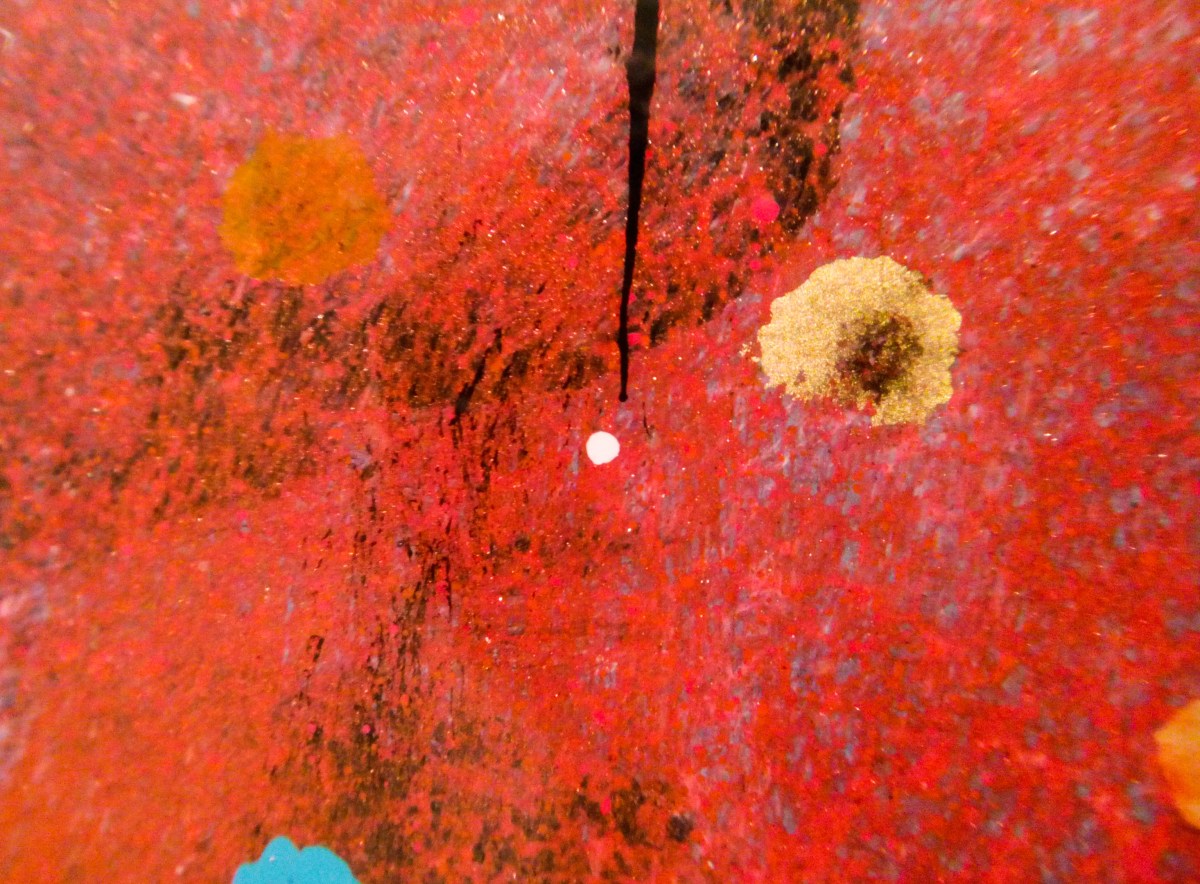
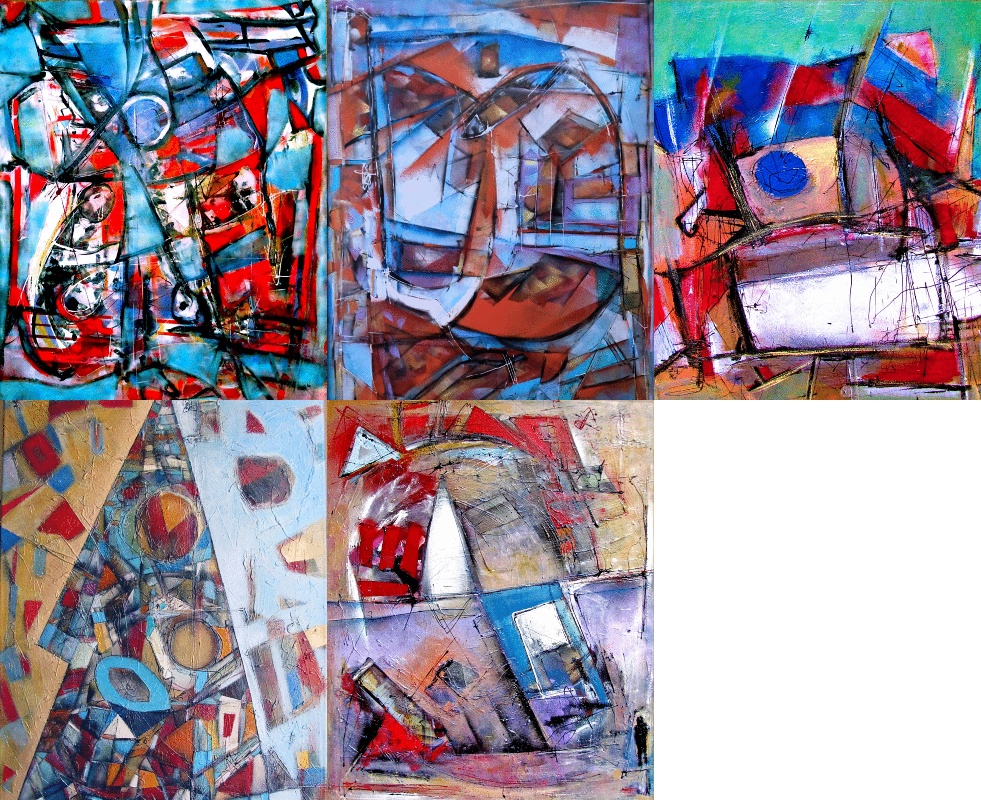
But even in each apparently “solid color”, which can seemingly be described as a red, or an ochre, or blue, there is an immense complexity of detail which gives to the eye the idea of one solid color. There is a minute, almost microscopic world of art, which lives beneath the apparent simplicity of one solid, elegant, simple description of color and which comes to life thanks to macro photography.
This slideshow requires JavaScript.
This is not a fluke. It is in fact by design. And this level of complexity and detail can be found, as I can demonstrate here below with some oher samples, in all of my paintings underneath the superficial explanation of its contents.
This slideshow requires JavaScript.
Thus, apparent simplicity hides a great deal of complexity that most, unless looking for it specifically, need not know. The simple answer exists and it is satisfying by itself. The complexity behind it also exists, and needs only to be known when the simple answer does not satisfy us.
So, having seen that simple and elegant may not be that simple or elegant beneath the surface, is the “simple and elegant answer” rule a good guide?
Even with all the questions still hanging around the subject, I would nevertheless venture to say “Yes”. It is a reasonable model to follow.
There are many reasons but I will just stick to these 4:
In my experience, the answer which simplifies the steps which need to be taken as well as the reasoning behind it, has a tendency to be more widely understood and therefore, more likely to be put into action. And an answer which is widely applied is, by its own definition, probably a correct answer at the time.
An explanation which simplifies a complex issue, and thus adds a certain elegance in a response, is very often the result of relating different occurrences to a single cause. Therefore eliminating unnecessary steps and making the response more widely applied as well.
Concurrently, longwinded, complex (“ugly”), and hard to understand answers or solutions will be more difficult to apply or prove, and thus less likely to be widely adopted, no matter their level of correctness.
This may be cheating, but many scientists and mathematicians have a rule of thumb. Known as Occam’s Razor (so named – or rather misnamed – for the English monk William of Ockham (or Occam), c.1285-c.1349 AD), this concept stands on the idea that if there are multiple plausible explanations for something, the simplest one will probably be the correct one. To avoid reductionism, one should add that this rule has a proviso that says “all things being equal”. In other words, it is mostly correct as long as you do not compare answers that put face to face bananas and apples.
So, is this becoming a dichotomist argument? Are we facing-off ugly vs elegant, or simple vs complex in an impossible battle? In reality, and as we have seen, what seems simple also hides intricacy. As a matter of fact, mothing in life is that easy, but almost everything should be approachable if explained in certain understandable terms. There is no battle here, but there is a probable winner nonetheless.
Whether in business, art, nature, mathematics or life itself, what we understand as answers that are, in relative terms, simple (ie: understandable, elegant, beautiful, non-repetitive, wider scoping, and so on) do run with an advantage over those seen as complex (difficult to fathom, convoluted, repetitive, ugly, non-organic, and so on).
“Simple” – elegant- answers hide within their nature the inherent complexity of life itself, but manage to show their results in a way that satisfy most. And as such, they tend to provide us with a healthy guide towards the right path. Furthermore, and coincidentally, being on the right path tends to also always be a beautiful experience.
Comparto con Uds. el prefacio de un trabajo de mi autoría que lleva como título “Creativos en la era de la Creatividad : Arte y Jazz – Algunos Conceptos y Propuestas (Tercera Revisión)”
Este trabajo, relacionado a mis clases como Profesor de Creatividad e Innovación en los MBAs de la Facultad de Economía de la Pontificia Universidad Católica Argentina (UCA), busca entrelazar conceptos relacionados a la actividad creativa en el Siglo XXI.
Espero que sea de interés.
Prefacio
Los estudios formales sobre creatividad comienzan sustancialmente hace casi un siglo. En el transcurso de estos casi 100 años mucho hemos aprendido sobre nuestra naturaleza, sobre nuestra manera de pensar y de imaginar las cosas, y sobre los métodos y herramientas que nos han hecho una civilización exitosa.
La búsqueda, como muchas de las búsquedas humanas, ha tenido el ojo puesto en encontrar la solución integral, el libro de oro, el santo grial de la creatividad que le dé respuesta a todo y resuelva todas nuestras necesidades creativas.
Sin embargo, y por suerte, no solo no lo hemos encontrado (más allá de convicciones temporarias), si no que exitosamente hemos ido comprendiendo que las respuestas no son siempre las mismas, que “leer el libro” no nos exime de pensar, que un sabio nos deje conceptos brillantes no nos exime de tomar decisiones, y que las respuestas en un mundo cambiante son también cambiantes y no necesariamente consecuentes con soluciones a problemas similares en otros momentos.
En otras palabras, hemos comprendido que el proceso creativo es creativo en sí mismo. Es cambiante, modificable, divertido y frustrante a la vez. Y hemos aprendido también que se trata de un proceso grupal y no individual.
La creatividad y la innovación, desde el punto de vista del desarrollo, es un proceso que nos involucra, nos obliga a abrirnos hacia los demás y hacia sus ideas y conceptos, nos hace reconocer la importancia del conjunto y no solo del individuo.
Se podría describir como un proceso casi comunitario. La solución, como en la vida en general, no proviene de una persona circunstancialmente iluminada, sino del correcto destilado de ideas, conceptos y sueños de un grupo de personalidades muchas veces complementarias y otras simplemente diferentes, trabajando parcialmente en conjunto y otras veces sin conocimiento el uno del otro, incorporando opiniones externas, y con el agregado de un porcentaje importante de hechos fortuitos pero que interpretados y utilizados correctamente, nos llevan a generar respuestas novedosas e innovadoras.
Hasta la visión de la persona que parece iluminada está conformada, por debajo de la superficie, por una enorme cantidad de conceptos, ideas, fracasos y aprendizajes de otras personas.
En definitiva, la creatividad vive y explota en cada momento de nuestras vidas y convive con nosotros. Y nuestro rol, diferente en cada ocasión y como parte de una foto más macro y compleja, es el de colaborar a encauzarla temporariamente en pos de un resultado.
Como veremos, existen soluciones muy probadas que pueden ser más y menos estructuradas, y más o menos exitosas.
En términos corporativos, por ejemplo, las soluciones que emanan de una estructura o formato probado por otras empresas – sistemas o procesos basados en programas (software) y un paquete de experiencias, ejemplos y soluciones pre-digeridas por ejemplo – son normalmente las preferidas.
La razón es que un “paquete” que ya fuera adoptado por otros es más fácil de vender para el originador, y es más justificable internamente a la hora de ser adquirido. Pero inclusive sin cuestionar el éxito relativo de cada una de estas propuestas, en el mejor de los casos éstas tienden a ser una posible solución de relativamente alto costo, y es solo accesible para las grandes organizaciones.
Solo entre un 10 y un 20% de la población activa que trabaja en estos temas, en el mejor de los casos, tendrá acceso a estas soluciones de manera directa o indirecta solo por el simple hecho de tratarse de soluciones costosas.
El resto trabajará en una gran empresa para luego independizarse, otros serán profesionales independientes toda la vida, otros generarán sus propios emprendimientos en soledad o asociados a otras personas, y otros trabajarán en relación de dependencia en una o más industrias a lo largo de su existencia. Y en todos los casos, sus experiencias laborales, profesionales y empresariales serán variadas, tanto en lo que refiere a los resultados como a las industrias.
Para estas personas que deben enfrentar cada día un mundo cambiante es que están dirigidos estos conceptos. Una manera de graficar esta realidad es comprender que a lo largo de nuestras vidas tendremos en promedio entre 5 y 6 trabajos (nuestros hijos entre 6 y 9), y que pese a que hemos sido entrenados clásicamente, el ecosistema económico ha dejado de obedecer esas reglas tradicionales y nos enfrenta con la necesidad de, inclusive, adaptarnos a profesiones o tareas inexistentes cuando ingresamos inicialmente al mercado laboral.
Es un hecho que las escuelas secundarias en el primer mundo acomodan hoy sus programas de estudio para darles a los estudiantes las herramientas que le permitan lidiar con trabajos, profesiones y vocaciones que sus profesores hoy desconocen ya que no existen como tales.
Hace un tiempo un profesional de unos 50 años, muy ofuscado, me preguntó “por qué en la empresa me insisten en que debo cambiar y ser más creativo, cuando he llegado a donde he llegado gracias a que soy como soy”. Y la respuesta no es fácil de digerir.
Nosotros, que venimos armados con un bagaje educativo mucho más clásico que los chicos que están terminando sus estudios y a punto de ingresar al mercado laboral, ya estamos debiendo enfrentar estos excitantes pero difíciles retos que indican que es probable que para el año 2030 (perfectamente dentro de nuestra vida laboral), cerca del 50% de los trabajos y profesiones actuales ya no serán necesarios y serán calificados como “obsoletos”i .
Ser creativos, entonces, tiene que ver con reconocernos como tales, y ser flexibles y adaptables a las nuevas necesidades laborales y tecnológicas. En el fondo es ser, en términos individuales y de manera consciente, lo mismo que ya hemos sido como civilización de manera evolutiva e intuitiva. Y desde ya, abrazar estos conceptos pasa también por comprender que no está escrito que porque la suerte nos haya acompañado hasta ahora, esa va a seguir siendo necesariamente la regla en nuestra vida profesional hasta que digamos basta. Ni más ni menos.
Por eso es que la visión vanguardista de la creatividad es la de colaborar en la creación de sistemas configurables y dúctiles como la vida misma. Es dotar a cada uno de una caja de herramientas y mostrarle las maneras en las que esas herramientas pueden ser utilizadas. No podemos ya confiar que en un libro, que en una teoría, o que en un sistema está La respuesta definitiva.
Hay una valiosísima experiencia investigativa acumulada y es necesario que se conozca, se interprete, y se respete. Al mismo tiempo hay que acompañar en el proceso de discernimiento, particularmente en relación a toda la información que fluye en el mar de datos que nos rodea, entre lo que es realmente importante para nuestras necesidades, y lo que no lo es.
Promover la adquisición de competencias que permitan enhebrar y relacionar toda esta información de manera productiva, y colaborar a mejorar la satisfacción individual de cada persona dentro de este ámbito es, entonces, nuestro objetivo.
El artista plástico Ignacio Alperín ha ganado notoriedad a nivel nacional e internacional con su arte movedizo y rítmico, conectado fuertemente al Jazz y a una movida marcadamente personal.
Por Cecilia Tvrdoñ
Cuando uno lee los comentarios sobre la obra del artista plástico Ignacio Alperín, uno nota que expertos y no expertos coinciden en ciertas frases: movimiento, ritmo, cadencia, color. Son todas palabras que buscan relatar de lo que se trata su obra, la cual por su fuerza y estilo tan personal, es difícil de encajonar en referencias clásicas definidas. Es fresca, intuitiva, innovadora y desde ya, muy alejada de lo que uno supondría al escuchar su historia.
¿Cuánto tiempo viviste en el extranjero?
Nací en la Argentina. Pero parte de mi infancia, y toda mi adolescencia y juventud, la viví en Australia, donde también estudié. Los que más me conocen dicen que soy un poquito Aussie. Además de Australia, y por razones laborales de mis padres, pude viajar mucho, e inclusive residir temporariamente en países como Singapur, Malasia, Francia e Italia. Volví a la Argentina en 1990 por curiosidad más que necesidad, y duré poco tiempo. Me “bañé” de realidad y me fui tambaleando como esos boxeadores que entran al ring sin estar preparados. Di vueltas por Inglaterra, Francia, Italia y retorné al país en 1997.
Finalmente te adaptaste.
No realmente. Pero tal vez ahora estoy como esos boxeadores a los que les pegaron tanto que ya no le importa (risas). En serio, lo que sucede si uno viene de crecer en un país anglosajón y pasa a nuestra cultura, es que hay diferencias fundamentales que cuestan congeniar. Más allá de que cuando volví a la Argentina hablaba castellano con un poco de acento gringo, creo que lo que me pasa tiene que ver con los códigos. Estoy muy feliz en mi país, pero tal vez se entienda si te digo que afuera extrañaba nuestra calidez humana, eso de ser familieros a toda costa (muy tano) y nuestro sentido del humor; mientras que estando acá extraño el respeto por los demás, el sentido de justicia social, y las reglas claras y similares para todos, que son las pautas con las que crecí en Australia.
¿Tu formación es puramente artística?
Se podría decir que el arte me acompaña desde que nací, ya que vengo de una familia muy abierta al arte y al diseño. Mi madre es una excelente dibujante que dejó de lado su pasión para formar una familia, pero nunca dejó de enseñarnos todo lo que sabía. Mi padre es un ingeniero con una carrera internacional que ha tenido muchos contactos con movimientos de vanguardia, tanto arquitectónicos como artísticos. Por todo ello mi primera formación fue más cercana al dibujo. En Australia, como parte de mi formación general, estudié artes visuales, e hice cursos y talleres. Pero en algún momento decidí encaminar mi propia exploración y allí es donde todavía me encuentro hoy.
¿Te dedicaste siempre al arte?
Pese a que el arte es la gran constante de mi vida, como considero que el ser humano debe responder con acciones a todas las necesidades intelectuales que se presentan (hacer algo con los dones que Dios nos ha dado sería una frase que siempre me inculcaron y que se me viene a la mente ahora) también estudié, entre otras cosas, Derecho, Ciencias Políticas, Relaciones Internacionales, y algo de Economía y Marketing.
Nada que ver con el arte… Sos el abogado pintor.
(Sonríe) Mirá, pinto, en el sentido más formal del concepto, desde los 12 años. Es algo que me ha acompañado siempre. Vendí mi primer cuadro en Australia a los 20 años, lo que marcaría el comienzo de mi carrera profesional de artista. Como también estudié otras profesiones, mi arte debió competir con otras responsabilidades, muchas veces ocupando el lugar de acompañante permanente y bálsamo para el alma. Y desde hace ya más de 10 años, la de artista es mi profesión principal.
¿Nos contás un poco más de tu alter ego profesional?
Para los que me conocen por primera vez, siempre les pregunto si quieren que hable como Bruce Wayne o como Batman (se ríe nuevamente). A simple vista parecen ser actividades muy alejadas entre sí. Pero la realidad es que hay un hilo conductor, y es que en todos yo soy yo. La vida hoy es muy compleja y en términos objetivos, es más larga. Ya la idea de pertenecer a una empresa toda tu vida y retirarte con el reloj de oro, pese a ser muy admirable, es casi imposible. El dinamismo del mercado, los altibajos económicos, y las presiones emocionales ligadas a un mundo donde todo es “ya”, hacen que los cambios laborales y profesionales no sólo sean casi inevitables, sino que hasta podrían considerarse muy sanos porque son como brisas de aire fresco que renuevan el “ambiente interior”. Pero no todo es fantástico. Admitamos que los momentos en los que algo terminó y lo nuevo no termina de concretarse, son momentos duros para todos. Pero creo fervientemente que la solución está casi siempre en nosotros mismos.
Perfecto, pero ¿y tu vida como Bruce Wayne?
(Se endereza) Tengo que tener el phisique du role para contestar. Estudié y estudio siempre. Tanto profesiones clásicas como en lo relacionado al arte (inclusive estudié teatro). Tengo el extraño honor de ser el primer argentino en la historia de Australia en recibirse de abogado. Hice una práctica en un estudio internacional en Melbourne y de allí me fui directo a trabajar en una empresa. Me desarrollé laboralmente en diferentes empresas y en diferentes países. Llegué a ser Gerente General de una S.A. y de mi propia empresa, Director Ejecutivo del Colegio de Abogados de la Ciudad de Buenos Aires, y Socio Gerente de un estudio extranjero entre otras cosas. Y hoy, en paralelo a mi arte, sigo dando charlas y conferencias sobre los procesos creativos, el arte y la creatividad en general, enfocado a empresas, profesionales y artistas. En fin… Muy Bruce Wayne.
Y mientras tanto el arte acechaba…
Yo diría que el arte ha sido y es mi compañero fiel de toda la vida. Dónde iba, mi arte iba conmigo. Y hoy en día es un trabajo full time, de 7 días a la semana.
¿Cómo definirías tu arte?
Si queremos darle un nombre tradicional, mi arte podría encuadrarse dentro de lo expresionista y abstracto. Mis series son generalmente basadas en el jazz particularmente, y en la música en general. Lo de Jazz Visual, o Visual Jazz, que es como se le conoce más popularmente aquí y afuera, responde a la denominación que le dio a mi obra una periodista norteamericana la primera vez que expuse en New York. Y la verdad es que me gustó porque de manera muy sintética, plasma lo que yo trato de generar como artista.
¿Qué tiene de diferente tu trabajo con la música, comparado a lo que hacen otros artistas, muchos de los cuales escuchan música también mientras trabajan?
Yo tengo sinestesia. No es algo malo, y para los que no la conocen, es una condición tan benigna del lóbulo frontal del cerebro que hasta hace algunos años no se podía diagnosticar fehacientemente y a nadie le importaba.
Inclusive hay un porcentaje importante de la población mundial que lo tiene y, algún médico me corregirá, se produce durante el proceso de gestación, dónde cierta característica del lóbulo frontal no se desarrolla o se desarrolla tal vez de otra manera a lo que se consideraría “normal”.
El resultado es que se producen conexiones neuronales fuera de lo común. Por ejemplo, hay personas que cuando escuchan ciertos sonidos se les generan sabores específicos (do es chocolate, re es frutilla… por dar un ejemplo simplificado).
En mi caso, mi sinestesia es leve, pero me permite “ver” formas y colores cuando escucho ciertos sonidos, particularmente música. En particular, encuentro que el Jazz y la música denominada “Clásica” genera los resultados más importantes. Y como amo el Jazz desde pequeño, es mi inspiración principal.
Esta cualidad, ¿estuvo siempre presente en tu obra?
Cuando era un joven artista me resistía a estos impulsos y no los plasmaba en mi obra. Los ignoraba ya que mi educación era más formal, y deseaba lo que muchos deseamos, que es ser aceptado.
Pero con el tiempo me di cuenta que lo que me hacía diferente (no digo original) era el hecho de que mi cerebro pudiese “ver” cosas que otros no veían. La inspiración no llegaba solamente a través de impulsos visuales, o puramente emocionales, sino que también a través de ondas que producía mi cerebro al verse estimulado por el sonido.
Ahí comprendí, que el respetar la “formalidad” le quitaba a mi trabajo, por un lado, esa elusiva característica individual que todos buscamos, y a mi vida de artista el disfrute de crear de una manera que me hacía verdaderamente feliz.
Y así fue como comencé, de a poco, a experimentar lo que hoy ya es una característica de mi obra. Logré así unir mi impronta, y mi capacidad de trabajo, con las posibilidades que este don me genera, y encontré la manera de fusionarlos y aprovecharlos artísticamente.
Y se nota en la vitalidad, los movimientos y el ritmo que hay en tu obra.
Esa “visión” de movimientos, formas y colores creo que hoy se plasman claramente en mi trabajo pese a ser marcadamente abstracto. Si no me equivoco, el comentario que más he escuchado sobre mi obra, sea de expertos (artistas, curadores, etc) como del público en general, es que se ven plasmados los ritmos, los movimientos, y las cadencias de la música de manera muy clara.
Me ha llevado años, pero igualmente, me hace muy feliz escucharlo.
Tal vez la reputación de tu obra ya me esté dando la respuesta, pero ¿encontrás que la obra abstracta es aceptada y valorada en nuestro país como en el extranjero?
Creo que la obra abstracta tiene su mercado en todo el mundo. La abstracción pictórica existe desde principios del siglo XX y va a seguir existiendo. Y sinceramente, tampoco creo que sea un problema que haya personas a las que no les guste la abstracción. Es más, están en todo su derecho. Y creo que es un tema que no pasa necesariamente por la educación, aunque comprenderla seguramente allana el camino para disfrutarla. Más bien intuyo que en general es un tema de gustos.
Igualmente te cuento que en la Argentina las obras abstractas tienen muchos adeptos, particularmente entre los coleccionistas de mediana edad y jóvenes, y eso claramente es muy bueno.
¿Manejás tu obra de manera personal?
El mercado del arte es muy complejo. Creo haber tenido la suerte de que mi obra haya sido resaltada en medios nacionales y extranjeros. Eso es fantástico desde el punto de vista de la validación externa que necesita el público que se acerca a la obra. Algunos curadores recomiendan mi obra y eso también es muy bueno. Pero no lo es todo.
Participo de eventos y ferias, generalmente por invitación, y elijo dónde participar. La elección no se basa en la fama de la feria o muestra necesariamente, pero en lo que en el momento también pueda resultar beneficioso para mi arte. Eso sí, nunca le digo que no a los eventos a beneficio.
También mantengo mi presencia a través de mi Sitio personal; de mi Blog; de un grupo, una Fan Page y una página personal en Facebook; de presencia en LinkedIn donde contribuyo con artículos en 7 grupos de arte. Tengo una substancial masa de seguidores en Twitter también, y todo ello requiere de tiempo y planificación.
Siempre que uno habla de la Red pareciera ser que no requiere trabajo. Se publica y listo. Pero creo que con lo que acabo de contar queda claro que, por un lado, promocionarse por Internet es un trabajo como como cualquier otro y requiere de tiempo, constancia y cierta precisión. Y la pata tradicional también lleva tiempo y esfuerzos.
Recordemos que además de todo eso, pinto, planifico, trabajo en mis objetos y diseños, y coordino la representación de mis obras. Es realmente un trabajo full-time.
¿Proyectos?
Proyectos y realidades siempre. Hoy, en paralelo a mi arte, sigo dando charlas y conferencias sobre los procesos creativos, el arte y la creatividad en general, enfocado a empresas, profesionales y artistas. No soy de los que anuncian sus proyectos futuros con asiduidad. Siento que la presión positiva que se genera al trabajar silenciosamente, pese a las ganas de contarlo a los cuatro vientos, es muy frágil. Se disipa fácilmente si uno genera expectativas y “desinfla” esa presión interior. Digamos simplemente que creo en el futuro, mío y en el del país, y estoy apostando para que podamos hacer grandes cosas juntos.
Si querés ver a Ignacio Alperín en acción, mirá la nota en YouTube, en el canal arteztvfull o bien en la fan page Artez Teve Programa de Televisión.
In 2013 I had the pleasure of participating in the 20th anniversaty celebrations of Buenos Aires famous Buenos Aires Design Shopping Mall. As part of these events I took part in Art Deco, an exhibition of furniture intervened by artists, where I presented my “Crystal Coffee Table (a le crayons).
Yet it took me a whole year to return to it and prepare a short video showing the photographs I had taken as I built it. A behind the scenes look, if you wish, on the work I had done.
Even though it does not show the process that went into thinking of it, planning it and any of the other details, I think it shows the complexity and at the same time, simplicity, of preparing this piece.
It also shows how the artistic object changes dramatically as it gets introduced in the cristal table which if anything, is bland and quite non specific.
There is a before and an after on the piece, and the video makes it very clear how the combination of two apparently unconnected ítems generates something new and much more powerful. They generate a completely new object of design, useful and at the same time, artistic
The most popular and competing Western languages in the world are English and Spanish.
For the Spanish speaker, the letter Ñ (roughly pronounced N-ee-A ) is like a symbol of this language´s uniqueness.
In Argentina, the top selling literature, arts and culture magazine, edited by CLARIN (the country´s most popular and largest selling newspaper) is properly called simply “Ñ”.
Yes, just a letter, but one that is the symbol of a whole language.
This magazine is published every Saturday and has average weekly sales of approximately 80,000 copies. Ñ, together with the LA NACION´s newspaper ADN (DNA in Spanish, and a different and perhaps more modern way of asserting where its cultural roots are), are the 2 most popular cultural magazines in the country.
I have been privileged enough to have been featured in both at different times, and it is always a proud moment when I can see my work reproduced in such prestigious and popular publications, and particularly when I find myself surrounded by articles on truly amazing local and international artists.
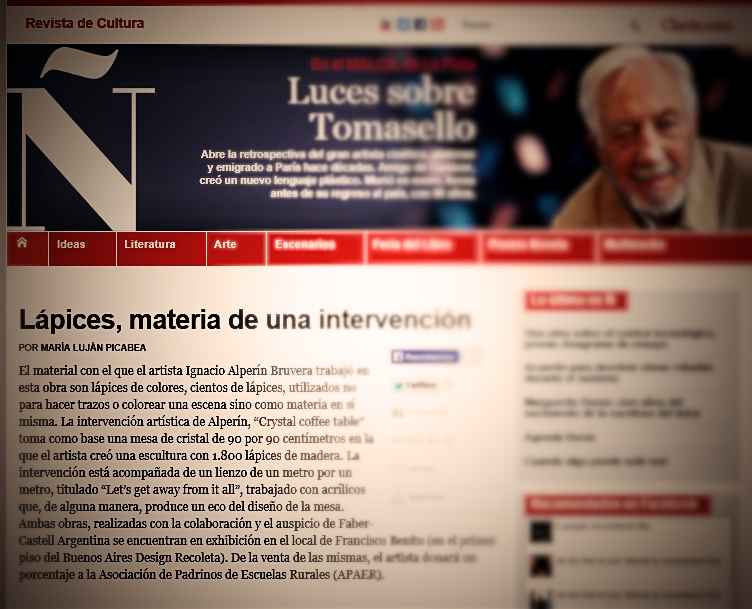
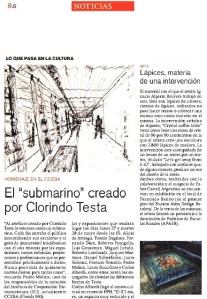
Last Saturday (May 25th ) I was surprised to find my latest intervention, and what has become so far this year´s one of my most popular works (my “Crystal coffee table with color pencils”), being featured on page 6.
It is always fun to see how a writer approaches a piece of work. I still remember a short article in the same magazine a couple of years ago, in which a journalist with immense generosity, compared and intertwined my work in my “Visual Jazz Series” with Julio Cortazar´s writings and his love for Jazz (for an explanation of how my art and music are interconnected, and particularly Jazz, check out “Jazz means freedom” at http://wp.me/pN8b8-9s ).
This time the reporter took a more clinical approach, which oddly enough I feel it is the right way to look at the piece.
First of all, because only a live viewing will reveal a certain depth and 3 dimensionality, that cannot be explained through a photograph. Secondly, because the piece is intriguing and that fuzziness is better left for the viewer to unravel, rather than subject it to an explanation that can only partially encompass all that it has to offer.
And I can only invite you, if you can, to have a look at it live at the Buenos Aires Design Shopping Mall, where it will be on show for a little while longer. And if you can´t, do not worry, at the very least I have some great pictures from the great Fabian Cañás which I have published here previously and on Facebook for you to look at and enjoy. I hope you do.
As everyone who knows me (www.ignacioalperin.com) knows, I am a maker of art and a lover of both art and music, particularly jazz and all its variations.
I have always endeavored to put both artistic forms of expression together, looking to synthesize them into new creations.
I have managed to do my own thing, but my love for the works of great geniouses like Kandinsky, Picasso, Van Koenig, Rauschenberg, and Pollock amongst others, will show through.
In music, even though my tastes are usually expressed in terms of the great bebop and hard bop masters like Evans, Coltrane, Monk, Davis, Pepper, Bird, and the golden era of American voices like Ella, Sinatra, Bennett, Dinah Washington, and Nina Simone, I am quite eclectic. I love classical music, tango, blues, soul, hip-hop and I can find inspiration in almost any tune that I enjoy, no matter its style.
Like I always say, music deserves a great deal of the credit in my art. “Inspiration is easy to find when you are perched on the shoulders of genius” is my usual response.
As I slowly entered into the realm of object design and sculpture, music was also there to inspire me, to make me “see”.
As many of you have seen, I recently introduced my latest piece at Art Deco, an Exhibition of intervened objects by well known Argentine artists, which took place at the Recoleta district in Buenos Aires in late April.
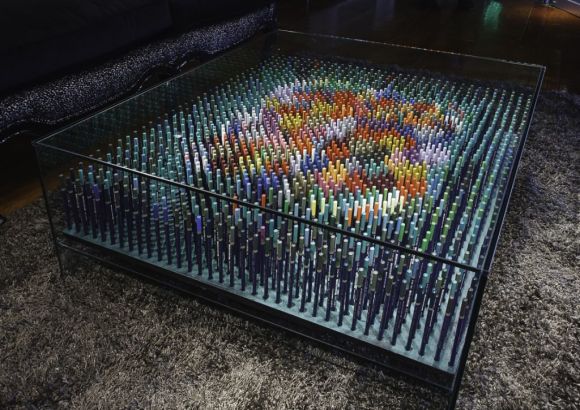
My design is quite simple. An all crystal coffee table within which, just like a transparent jewel box, In which I placed a sculptural piece made up of more than 1800 Faber-Castell Goldfaber artistic pencils standing perpendicularly and making up a colorful and airy version of the painting that lurches beneath.
It strikes me that every person, whether young or old, who has stood in front of the finished table ends up drawing out a big and happy smile. The color pencils create a link to something very familiar, something warm within each one of us, and initiate the communication with the viewer immediately.
This slideshow requires JavaScript.
The idea of using pencils for this intervention came to me as I watched a Tony Bennett documentary a while back. I already had the crystal table and listening to that genius sing made me close my eyes, and suddenly I saw it. It was like a clear box full of candy, the idea of the beautiful color pencils used as objects d’art instead as of instruments was born. I know others have explored this avenue, but I think I have managed to make it both artistic and utilitarian, with a cool twist. I am happy with the results and with the reaction of the public. It has been a wonderful experience.
And to me, it is important that my art also has that COOL factor. It is a style and it is a message. Art is not something rigid, stuck somewhere in an impregnable limbo. It is something to be enjoyed. My art is a message of fredom and cool, for all to enjoy, in any way they wish to enjoy it.
And of course, preferably at home, after acquiring it!!! 🙂
And talking about cool, enjoy the images of my latest work while you listen to the new 60’s Jazz scene B&W video of Justin Timberlake’s latest (featuring Jay Z). It seems that JT, just like me, also likes doing his thing with a Suit & Tie.
Until the next time!
Ignacio
—————
Art and Design: Ignacio Alperin Bruvera
Photos: Fabian Cañas.
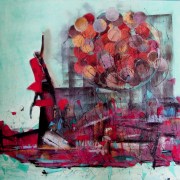
Painting accompanying the table in photos: “Let´s get away from it all” (2012) by Ignacio Alperin Bruvera, 100cm x 100cm.


 Con una nutrida concurrencia de artistas y creativos, dedicamos un poco más de dos horas a indagar el por qué de estos procesos, y a comprender que podemos domarlos, alejándonos de lo imprevisto y de lo fortuito, convirtiéndolos así en nuestras armas de uso intensivo.
 and creatives, for the kind words afterwards, and for Ligia´s kind invitation and superb energy and care.


 characteristics tend to be a good omen that a correct formula is close by (Newton said, for example, that “Nature is pleased with simplicity” while Aristotle made a point in favor of simplicity by advocating as few as possible postulates).

 conjunction of situations, equations, “random coincidences”, and an uncertain prequel and origin we have been able not to ever explain at this time.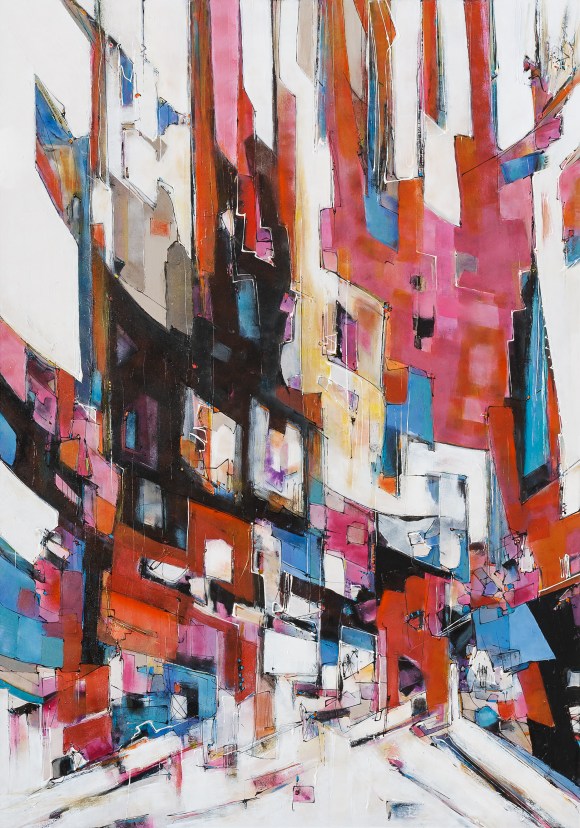
 multiple plausible explanations for something, the simplest one will probably be the correct one. To avoid reductionism, one should add that this rule has a proviso that says “all things being equal”. In other words, it is mostly correct as long as you do not compare answers that put face to face bananas and apples.





 The most popular and competing Western languages in the world are English and Spanish.



 IGNACIO ALPERIN: THE ART OF THINKING OUT LOUD / EL ARTE DE PENSAR EN VOZ ALTA